
For most businesses under about 75 employees, the answer is an MSP with a serious security stack, not a standalone MSSP. An MSSP earns its fee when you already have IT covered, either an internal team or a managed IT provider, and compliance or risk demands a dedicated 24/7 security operation on top.
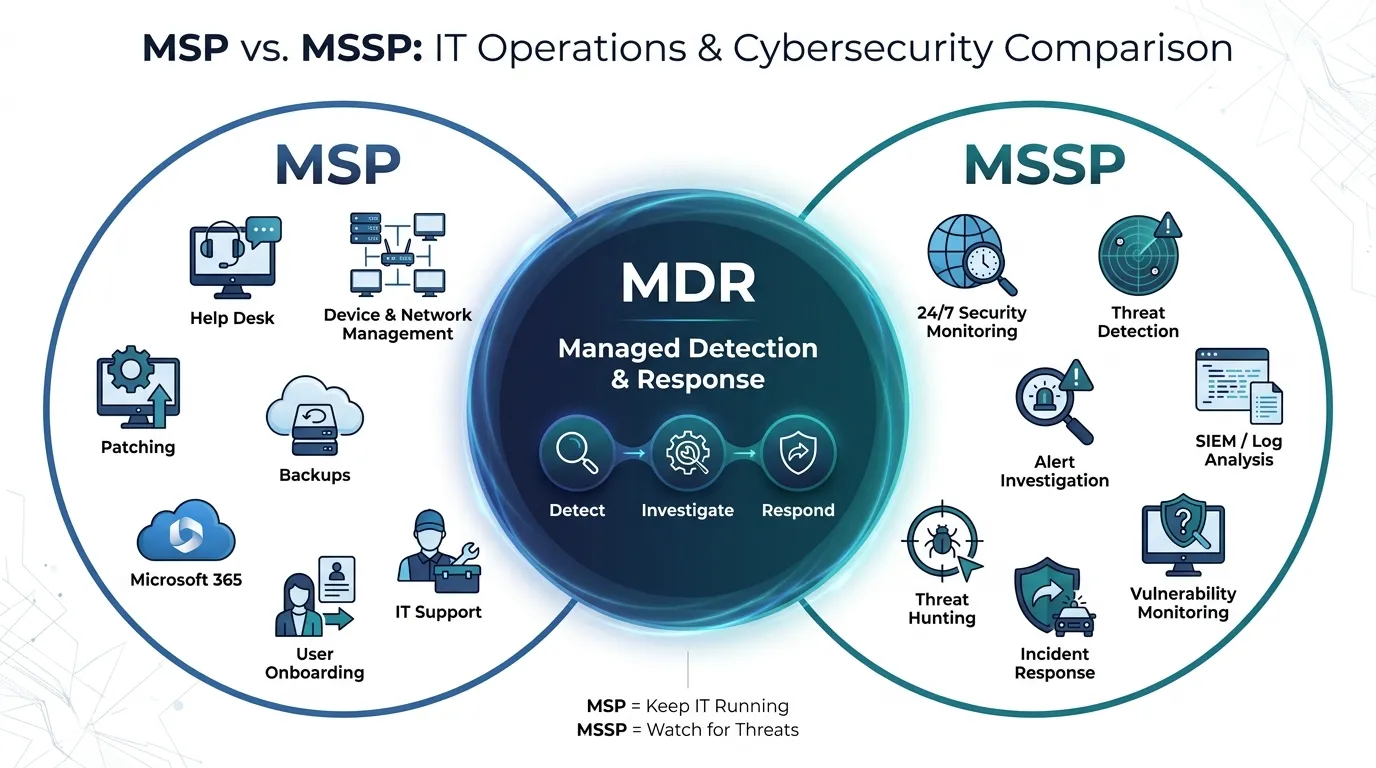
The acronyms make it sound like a coin flip. It isn’t. An MSP runs your technology. An MSSP watches it for attackers. One replaces your IT department; the other replaces a security team most small businesses never had. We run managed cybersecurity services alongside day-to-day IT for offices across North Texas, so we sit on both sides of this line, and we’ll tell you where each choice goes wrong.
MSP vs MSSP at a glance
| Criterion | MSP | MSSP |
|---|---|---|
| Core job | Keep systems running: help desk, patching, backups, users | Detect and respond to threats: monitoring, alerts, investigation |
| Fixes your printer | Yes | No, and they’ll be annoyed you asked |
| Watches for attackers | Baseline tools, business-hours attention | Dedicated 24/7 security operations center |
| Typical buyer | 5–100 employees, no internal IT | Companies with IT already handled, or heavy compliance |
| Pricing shape | Per user per month, all-in | Per device/log volume, security only |
| Blind spot | Security depth varies wildly by provider | Won’t touch the day-to-day IT that creates the risk |
What an MSP actually covers
A managed service provider takes over the running of your technology for a flat monthly fee: monitoring hardware, applying patches, running backups, answering the help desk, onboarding new hires, managing Microsoft 365. Security is part of the job, but it’s one lane of a wide road. If you’re fuzzy on the model itself, we wrote a full breakdown of what an MSP actually is.
Here’s the honest part most comparison articles skip: MSP security depth ranges from excellent to decorative. Some shops deploy real endpoint detection, enforce MFA everywhere, and review logs daily. Others install antivirus, check the “security” box on the proposal, and hope. Same acronym, wildly different risk.
What an MSSP actually covers
A managed security service provider does one thing: security operations. They collect logs from your firewalls, servers, and endpoints into a SIEM, staff analysts around the clock, investigate alerts, and call you at 3 a.m. when something’s genuinely wrong. Good ones also run vulnerability scanning, threat hunting, and compliance reporting.
What they don’t do is fix anything outside security. Server down? Not their problem. Backup failing? Also not their problem, right up until the ransomware event where it becomes everyone’s problem. An MSSP layered over badly-run IT is a smoke detector in a house with a gas leak.
Where the line blurs in 2026
The clean MSP/MSSP split is dissolving, and MDR is the solvent. Managed detection and response gives you MSSP-grade monitoring, 24/7 human analysts included, as a service an MSP can build into its stack. That’s our model: we handle IT and fold MDR in, so the people watching your alerts are one phone call from the people who can actually remediate. Our plain-English MDR explainer covers how that works under the hood.
Our take: for small business, the MSP-with-MDR model beats the two-vendor arrangement in the scenario that matters most, which is an active incident. When detection and remediation live under separate contracts, containment slows down while two companies establish whose scope the fire is in. We’ve watched that handoff cost hours. Hours are the whole game in ransomware.
One practical warning if you do buy separately: audit the overlap before signing. MSP stacks and MSSP proposals frequently both include endpoint agents, email filtering, and vulnerability scanning, and nobody volunteers that you’re about to pay for two of each. We’ve reviewed quotes where a third of the MSSP fee duplicated tooling the MSP already billed. Put both scopes in one spreadsheet, line by line, and make each vendor initial what’s exclusively theirs.
Choose an MSP if / choose an MSSP if
Choose an MSP (with a verified security stack) if: you have no internal IT, you’re under roughly 100 employees, and you need the whole job done: support, uptime, and security in one throat to choke. Verify the security half. Ask what EDR they deploy, who reviews alerts overnight, and when they last restored a backup for real.
Choose an MSSP if: you already have competent IT, internal or outsourced, and you face requirements that demand independent 24/7 monitoring: defense contracts, insurance mandates, or a board that wants a second set of eyes. A 120-person company with two internal IT staff is a classic MSSP customer.
Choose both if: a regulator or framework effectively says so. Accounting and finance firms covered by the FTC Safeguards Rule have to implement and continuously monitor a written security program, and CMMC-bound defense suppliers face similar monitoring expectations. At that point the question isn’t either/or, it’s who supplies which layer.
A tale of two Plano offices
Two real patterns from our market. A 20-person financial advisory near Legacy Drive asked us to quote an MSSP because a conference speaker scared them. They had no MSP, patching was months behind, and offboarding was “eventually.” An MSSP would’ve billed them monthly to watch preventable problems happen. What they needed first was IT support in Plano that closed the basics, with MDR layered in from day one.
Across town, a 90-person firm with two sharp internal IT guys wanted us to take over everything. Wrong direction. Their team knew the environment cold; what they lacked was overnight security coverage and log correlation. A security-only engagement fit. Selling them full management would’ve been profitable for us and wasteful for them.
If it were our building: under 50 seats, we’d pick one accountable provider running both IT and security, then audit their security claims annually. Over 100 seats with internal IT, we’d add dedicated security monitoring and make the two teams share an incident runbook before, not during, the first incident. The full control list lives in our owner’s cybersecurity playbook.
Not sure which side of the line you’re on? Tell us what you’re running and we’ll say so plainly, even if the answer is “keep your internal team and don’t hire us for that.”
Frequently Asked Questions
What does MSSP stand for?
When should a business hire an MSSP?
Can an MSP also be an MSSP?
Is an MSSP more expensive than an MSP?
The short version
An MSP keeps the business running. An MSSP watches for the people trying to stop it. Most owners reading this need the first one, done well, with real detection built in, and only graduate to dedicated security monitoring as headcount and compliance grow. If you want a second opinion on a quote from either camp, talk to an IT specialist and bring the proposal. We’ll mark it up honestly.