
What is SIP trunking? It’s a way to connect the phone system you already own to the public phone network over your internet connection instead of over copper phone lines. Your desk phones, extensions and auto-attendant stay put. Only the dial tone changes, and it usually gets cheaper and far easier to reroute when something breaks.
It gets confusing because vendors sell SIP trunking services with the same vocabulary they use for hosted phone systems, and those are different purchases. One swaps the lines. The other replaces the whole phone system. Below: how it works, how it compares with the PRI circuit it usually replaces, what it costs, and six questions for any provider.
What is SIP trunking, and how does it work?
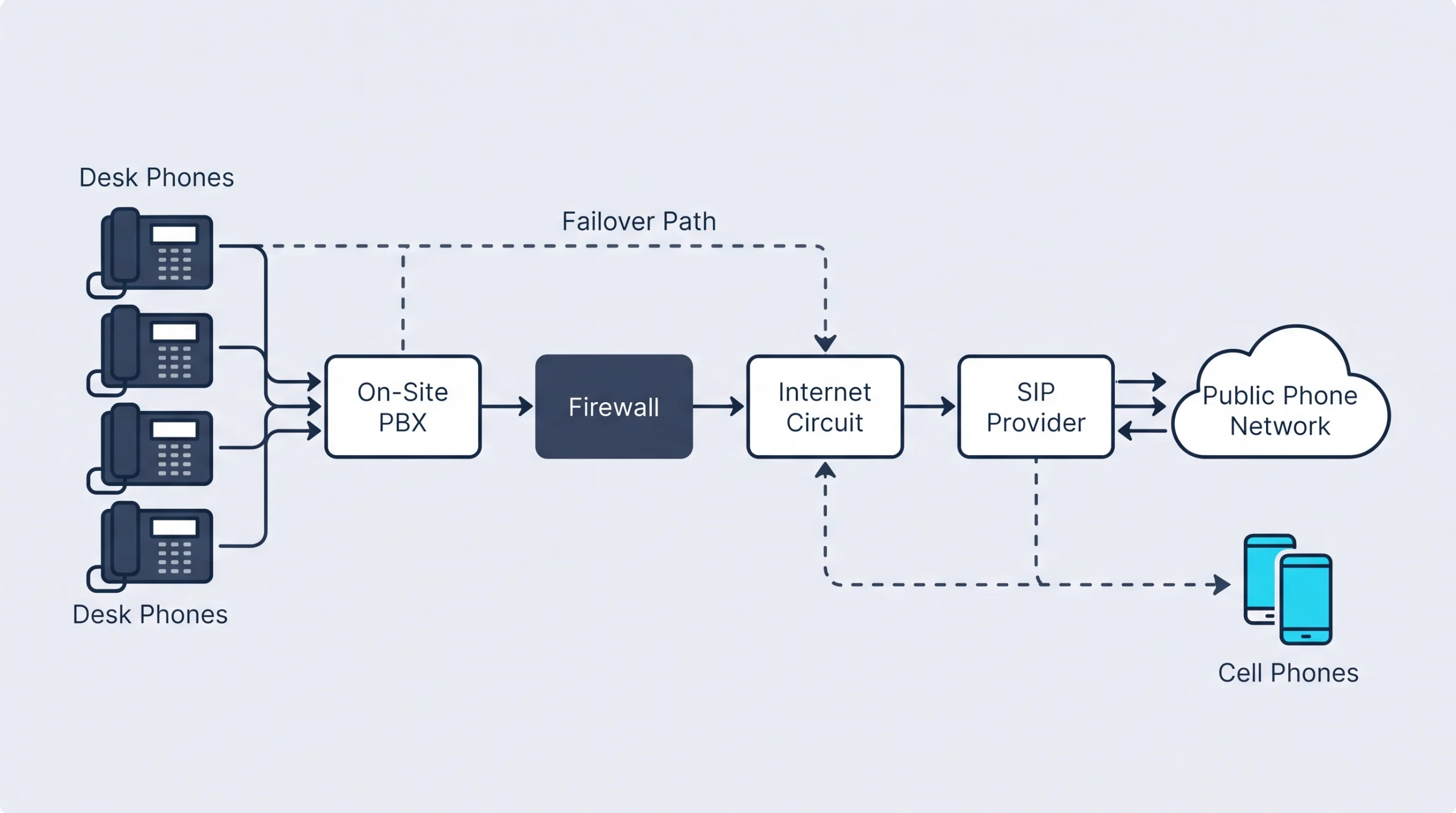
SIP trunking is phone service delivered as data. Your phone system (the PBX) sends calls across your internet circuit to a SIP provider, and the provider hands them to the public telephone network. “SIP” is the signaling language that sets calls up and ends them. “Trunk” is the bundle of call paths you rent.
Three pieces are involved, and knowing them heads off most sales confusion.
The PBX. The box that runs your extensions, voicemail and call routing. It has to speak SIP, or it needs a small gateway that translates.
The channels. A channel is one simultaneous call. Ten channels means ten people can be on outside calls at once, no matter how many phones or numbers you have.
The numbers. Your main line and direct-dial numbers are labels that point at the trunk. You can have 5 channels and 60 numbers. People mix these two up constantly, and it’s the most common reason a first SIP quote looks too high: somebody priced one channel per employee.
So how many channels do you need? Count your busiest moment, not your headcount. A typical office runs about one channel for every three or four employees. A call-heavy team like scheduling or dispatch runs closer to one for every one or two.
Bandwidth is rarely the constraint. An uncompressed call uses roughly 87 kbps in each direction once network overhead is counted, per Cisco’s per-call bandwidth figures, so twelve simultaneous calls need about 1 Mbps. Almost any business circuit can carry that.
SIP vs PRI: what changes
A PRI is the older way to do the same job: a dedicated T1 circuit from the phone company that carries 23 calls at once. SIP trunking does it over internet instead. You buy only the call paths you need, add more the same day, and reroute calls automatically if your building goes dark.
Those cost figures are typical market ranges, not a quote from us, and taxes and fees sit on top of both. The pattern holds anyway. Most offices paying for 23 PRI channels use fewer than half of them at their busiest minute.
Run it with typical numbers. Take a 35-person insurance agency off Valley Mills Drive in Waco with one PRI at $480 a month. Call logs show a peak of nine simultaneous calls. Twelve SIP channels at $22 each is $264. That’s about $2,600 a year back, and the agency gains something the PRI never offered: if a storm takes out the building, calls roll to the agents’ cell phones without anyone driving in. It’s the kind of review we run for businesses that count on us for IT support in Waco, and the answer isn’t always “switch.”
Our take: the savings are real, but failover is the better reason. A PRI ties your phone numbers to one building. SIP ties them to an account you can point anywhere.
Why a business owner should care
Money, covered above, and risk. Carriers have spent years moving off the copper network that PRIs ride on, and PRI renewals tend to come back higher each cycle with slower repair commitments. Staying put is becoming the expensive choice.
SIP trunking or hosted VoIP: which are you shopping for?
SIP trunking keeps your on-site phone system and replaces only the lines. Hosted VoIP, also called cloud PBX, removes the on-site system and rents you the whole thing per user. Our guide to how VoIP works walks through both designs.
SIP trunking makes sense when the PBX is healthy: under seven or eight years old, still supported by its manufacturer, paid off, and wired into things that are painful to move, like overhead paging, door phones or call recording. Hosted makes sense when the PBX is aging, when half the staff works remotely, or when nobody on site wants to own a phone server.
If it were our building: we wouldn’t bolt SIP trunks onto a PBX that’s out of manufacturer support. You’d be buying a gateway to extend the life of the part most likely to fail. Put that money toward the replacement.
What SIP trunking costs
In our market, expect unmetered SIP channels in the $15–$30 range per channel per month, or metered plans that bill around a penny a minute with a small monthly minimum. Phone numbers add a few dollars each. One-time costs are number porting and, for an older PBX, a gateway. For the full picture including hosted plans, see our breakdown of business VoIP costs and hidden fees.
Want a second set of eyes on a quote? Send us the proposal and your last phone bill. We’ll tell you how many channels you really need.
Choosing a SIP trunking provider: six questions
Price per channel is the least interesting difference between providers. These questions separate them.
How do you handle 911?
What happens when my internet drops?
Will my outbound calls be flagged as spam?
Who ports the numbers, and how long does it take?
What about fax, alarm panels and the elevator phone?
Who owns the problem when calls sound bad?
That last question is the case for having one company manage the network and the phones. Voice quality lives in the firewall and switch configuration. When the same team owns the firewall, the PBX and the trunk relationship, there’s nobody left to point at.

Two misconceptions worth correcting
“We’d have to replace all our phones.” No. That’s hosted VoIP. With SIP trunking, staff shouldn’t notice anything changed except, possibly, a clearer line.
“It’s only as reliable as our internet.” Half true. A single circuit with no failover is a real risk. A business circuit with automatic failover is more resilient than the PRI it replaced, because the PRI had exactly one path and no plan B.
Frequently Asked Questions
Is SIP trunking the same as VoIP?
How many SIP channels does my business need?
Can I keep my phone numbers when I switch to SIP trunking?
Does SIP trunking work with 911?
Keep the phones, change the lines
Keep the phone system, replace the lines, and gain a way to keep answering when the building can’t. For a straight read on whether your PBX is worth keeping, book a free IT consultation and bring a phone bill. We’ll do the channel math with you.