
Texas security camera laws let a business record video anywhere people have no reasonable expectation of privacy: sales floors, offices, hallways, entrances and parking lots. Two lines are firm. No cameras in bathrooms, changing rooms or anywhere else people undress, and no recording audio of conversations you’re not part of.
Most businesses stay on the right side of the first line without trying. The second is where the trouble is, because plenty of cameras ship with a microphone switched on. We design compliant video surveillance systems for Texas businesses, and this is how we explain the rules to clients. It’s general information from security practitioners, not legal advice. For anything with real exposure, such as audio or facial recognition, ask your attorney.
Texas security camera laws on video: what you can record
Texas has no statute that stops a business from recording video on its own premises in areas open to customers or employees. The question courts ask is whether a person would reasonably expect privacy in that spot. On a sales floor, at a loading dock or in a parking lot, they wouldn’t.
That covers nearly every position in a normal camera design, which we lay out in our camera placement guide.
Where cameras are illegal: bathrooms, changing rooms and private spaces
Under Texas Penal Code § 21.15, it’s an offense to photograph or record a person in a place where they have a reasonable expectation of privacy, without consent and with intent to invade that person’s privacy. Since September 1, 2025, the statute defines that as any place a reasonable person would believe they could undress in private, and it names bathrooms, bedrooms and changing rooms. Changing rooms include dressing rooms, locker rooms and swimwear changing areas. The offense is a state jail felony.
A sign doesn’t fix it. The statute says a posted notice that recording is taking place is not enough to establish consent in any of those places.
In practice, retail fitting rooms get a camera on the corridor outside, never inside. Gyms cover the locker room door from the hallway. We check that no camera’s view reaches into a restroom when the door swings open, and we now treat lactation rooms and exam rooms as off limits too.
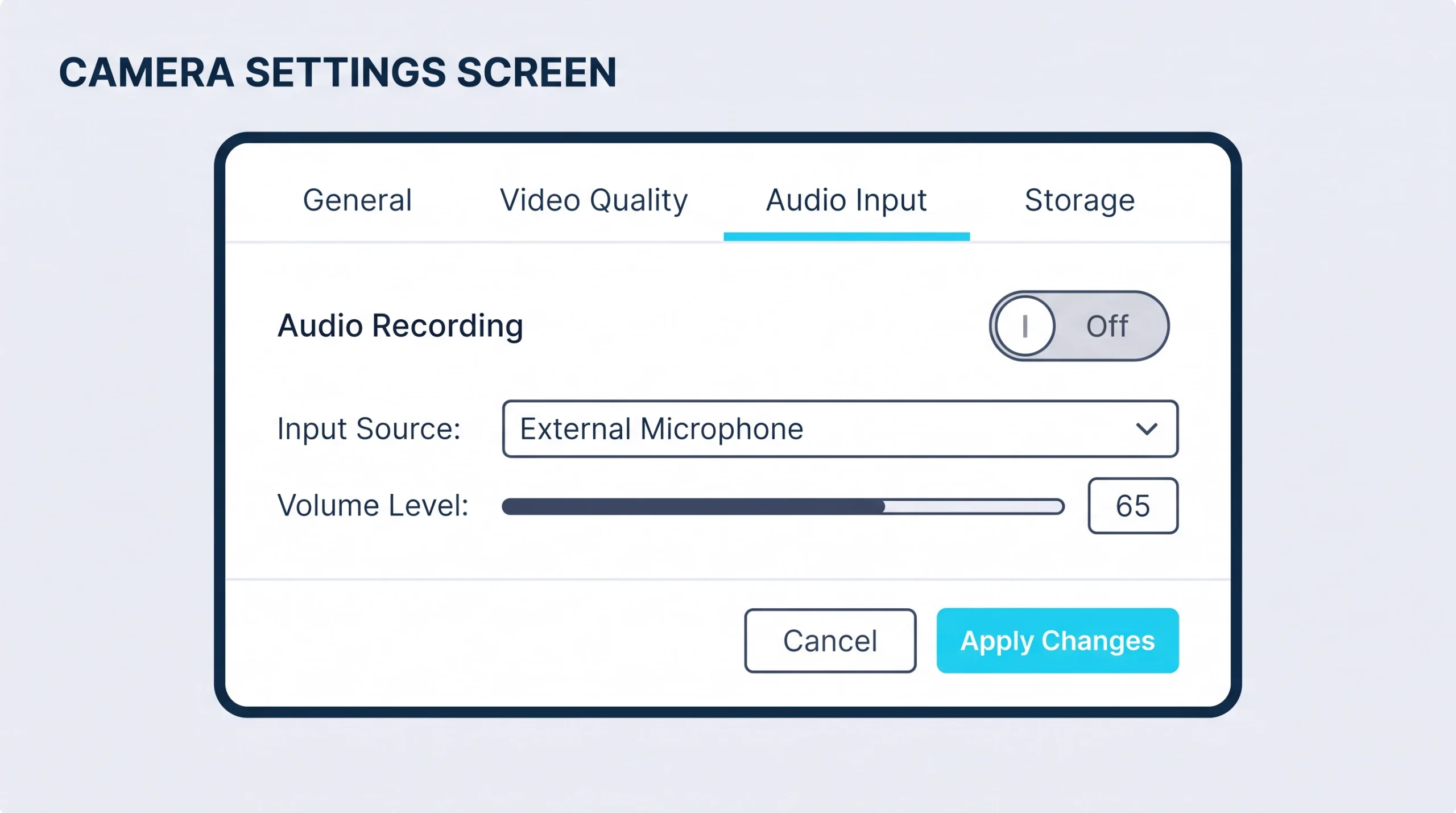
Audio recording: the rule most camera systems break
Texas is a one-party consent state. Under Penal Code § 16.02, intentionally intercepting an oral communication is an offense, and the defense is that you were a party to the conversation or one of the parties consented beforehand. Federal law has the same structure in 18 U.S.C. § 2511.
A camera microphone above a dining room isn’t a party to anything. Two customers talking at table six haven’t consented. The statute protects conversations people reasonably expect aren’t being recorded, and a quiet table conversation is not where you want to test that.
The criminal offense is generally a second-degree felony. Separately, Civil Practice and Remedies Code Chapter 123 gives a recorded person a civil claim with statutory damages of $10,000 per occurrence, plus attorney’s fees.
Take a restaurant on Magnolia Avenue in Fort Worth with twelve new cameras. Five have built-in microphones, enabled out of the box, picking up every conversation in range. Nobody asked for audio, and nobody knows it’s on. That restaurant is now storing thirty days of recordings it very likely had no right to make. Live microphones nobody requested are a standing item on our takeover checklist across our Fort Worth service area for exactly that reason.
If it were our building: audio off on every camera by default. If there’s a real need at one spot, such as a service counter where disputes happen, that’s a decision for you and your attorney, with posted notice.
Cameras in the workplace laws: what employers can do
Texas employers can use video cameras in work areas, and we know of no state law requiring advance notice to employees. The limits are private spaces, audio, and federal labor law, which bars surveillance aimed at union or other protected group activity. A written camera policy that employees sign is the practical safeguard.
The federal piece surprises non-union employers. The National Labor Relations Board lists photographing or videotaping employees engaged in peaceful union or other protected activities, and spying on those activities, as unlawful interference. Those protections cover employees discussing pay and working conditions whether or not a union exists.
Timing matters. Cameras installed for security and left alone are one thing. A new camera aimed at the break room the week after employees start comparing wages is another.
A good policy is one page: where cameras are, why, that audio isn’t recorded, who can view footage, and how long it’s kept.
Facial recognition and biometric features
Many current recorders can match faces against a list. In Texas, switching that on is a legal decision. Business and Commerce Code § 503.001 treats a record of face geometry as a biometric identifier. A business can’t capture one for a commercial purpose without first informing the person and getting consent, and it has to destroy the data within a reasonable time, no later than a year after the purpose ends. The attorney general can seek civil penalties of up to $25,000 per violation.
Ordinary analytics that detect “a person” or “a vehicle” don’t identify anyone. Features that recognize who a person is are what the statute targets.
One wrinkle. Since January 1, 2026, the statute exempts AI systems deployed to prevent or detect security incidents, fraud or other illegal activity. Whether a camera’s face-match list qualifies is untested as far as we know, so treat consent as the rule until your attorney says otherwise.
We’d skip face matching unless there’s a specific problem it solves and counsel has approved the consent process.
Signs, retention and footage requests
Signs. We know of no Texas statute that requires a business to post a sign for video recording in public areas. Signs are still worth having for deterrence, and cities can add their own rules. Dallas requires convenience stores to post “STORE IS UNDER CAMERA SURVEILLANCE” at each public door under City Code Chapter 12B.
Retention. Texas sets no general retention period for private businesses. Your insurer, your industry or your city may. The same Dallas ordinance requires 30 days.
Requests. When an incident happens, export the footage that day. Recorders overwrite their oldest video automatically.
If your project includes an alarm, cities layer permit rules on top. Our Dallas alarm permit guide covers those.
Who’s allowed to install cameras in Texas
Occupations Code Chapter 1702 defines an alarm system to include a camera system that records or archives images of property or individuals. A company that sells or installs one needs a license from the Texas DPS Private Security program. Ours is B10492801.
Our take: ask any installer two questions before signing. What’s your license number, and will the microphones be on? The first answer tells you whether they’re legal. The second tells you whether they’ve thought about your exposure.
Inherited a camera system and not sure what it records? Ask for a walkthrough. We’ll check every camera for audio, private-area views and analytics settings, and give you the list.
Frequently Asked Questions
Is it legal to have security cameras at a business in Texas?
Can security cameras record audio in Texas?
Do you have to post a sign for security cameras in Texas?
Can an employer have cameras in the workplace in Texas?
Know what your cameras record
Video in public areas is fine, private rooms are off limits, and audio is where businesses get hurt without knowing it. If nobody can say for certain what your current system captures, talk to an IT specialist and we’ll audit it with you.