
How much does an access control system cost? In the DFW market, plan on $1,500–$3,500 per door, installed, for a standard card or mobile reader on a commercial door, plus $5–$15 per door per month if the software lives in the cloud. A four-door office usually lands between $7,000 and $13,000.
That’s the access control system cost most owners are trying to pin down, and the range is wide for a reason. The reader on the wall is the cheap part. The lock hardware, the door itself, the cable path and the permit decide where your quote falls. We’ve priced enough access control installation projects across North Texas to show you where the money goes, door by door.
Access control pricing by door type
These are typical ranges from quotes in our market. They aren’t a Texas Communication Services price list, and your building gets its own number after a walkthrough.
What drives access control system cost per door?
Six things move the number: the door and frame, the lock type, the cable path, the controller design, the credentials and the software model. The door itself usually matters most. Two openings ten feet apart can price $1,500 apart because one has a steel frame with a latch and the other is frameless glass.
1. The door and frame. A hollow metal frame with a standard latch takes an electric strike in an hour or two. An aluminum storefront door with a narrow stile needs a strike made for that latch, or a mag lock. Frameless glass needs a mag lock with glass brackets and surface raceway. Expect the difficult door to add $500–$1,500.
2. The lock type. Mag lock or electric strike. That one gets its own section below.
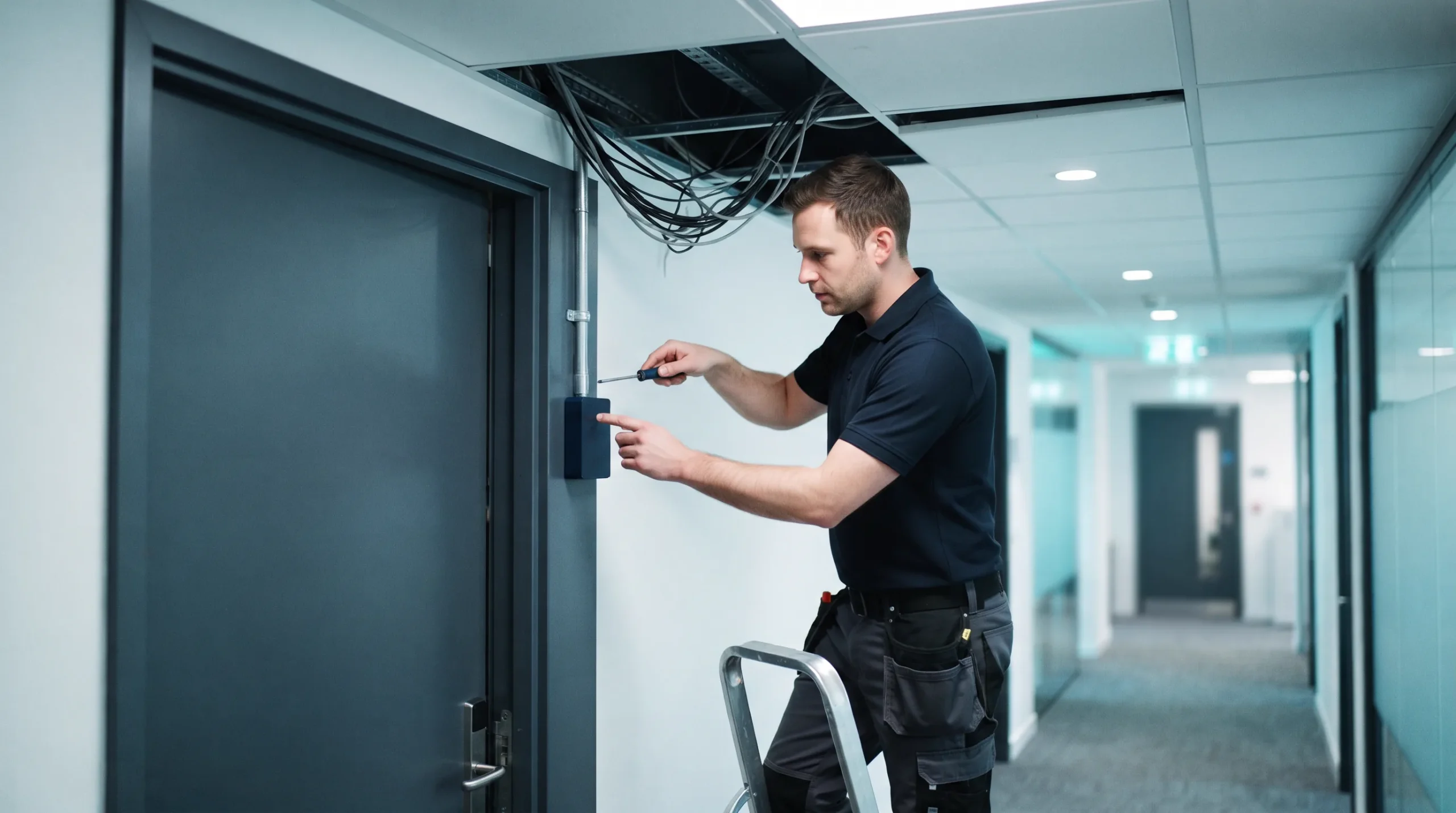
3. The cable path. Every door needs a composite cable back to a controller. Above an open drop ceiling, that’s a 60–90 minute pull. Through a hard-lid ceiling or a fire-rated wall, it can eat most of a day. Licensed low-voltage labor in DFW typically bills $85–$125 an hour.
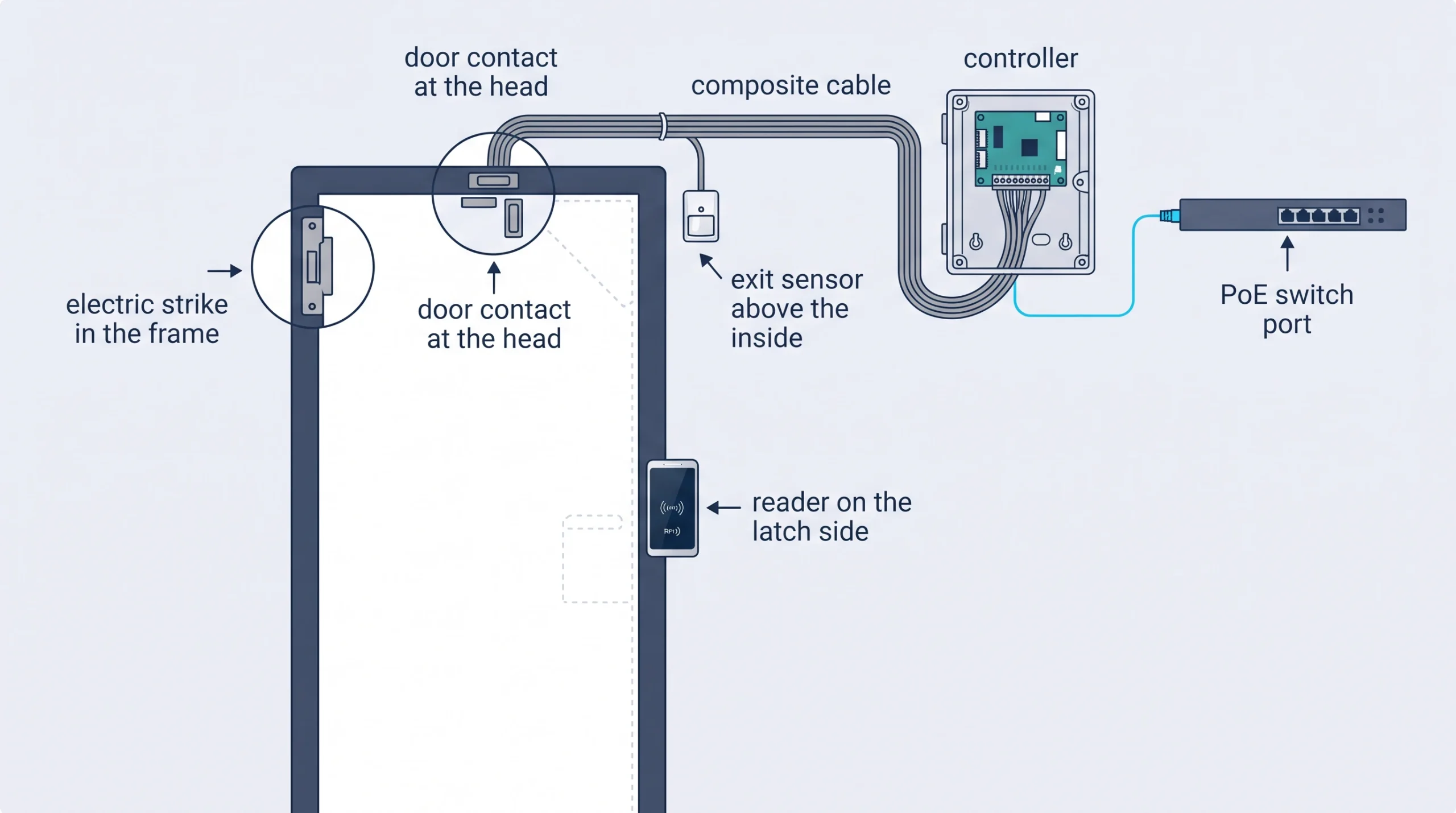
4. Controller design. Per-door PoE controllers ($400–$900 each) suit small or spread-out sites. Central panels cost less per door once you pass about eight, but every door’s cable has to home-run to the panel.
5. Credentials. Fobs and cards run $3–$10 apiece. We cover how key fob entry systems work and what the fobs cost separately, including why the cheapest fobs are a security problem.
6. The software model. On-premise software is a one-time license, commonly $500–$3,000, plus a server someone has to patch. Cloud platforms charge per door, per month. Our guide to mobile and cloud-based access control compares the two.
Mag lock vs electric strike: which costs more?
The hardware costs about the same, $150–$400 either way. The mag lock door still ends up $400–$1,000 more expensive once you add the code-required exit devices and the fire alarm tie-in. An electric strike keeps your existing latch and lever, so it’s usually the cheaper install.
Here’s why. An electric strike replaces the strike plate in the frame. Your latch still latches, and the inside lever always lets people out mechanically. A mag lock is an electromagnet on the header holding the door shut with 600 or 1,200 pounds of force, and the handle does nothing to release it. So the egress rules in Chapter 10 of the International Building Code, which Texas cities adopt with local amendments, require a sensor that unlocks the door as someone approaches, a push-to-exit button that cuts lock power directly, and automatic release on fire alarm or power loss.
Our take: if the door has a latch and a frame that will take a strike, we use a strike. We save mag locks for frameless glass and the odd door where nothing else fits.
The local wrinkle: the Frisco Fire Department lists access control systems among the work that requires a fire permit and plan submittal, and several neighboring cities review electrified locks the same way. Build the review time into your schedule before you promise staff a go-live date.
Line-item breakdown for one standard door
Three DFW scenarios with real math
Two-door dental office. One hollow metal staff entrance and one storefront patient door. The staff door prices at $1,800–$2,600 with a strike, the storefront at $2,500–$4,000. Total: $4,300–$6,600, plus $10–$30 a month for cloud software.
Eight-door professional office in Frisco. Picture a 45-person engineering firm near the Dallas North Tollway: two storefront entries, a rear door, and five interior doors including the IT closet and a records room. Six standard doors at $1,500–$2,800 come to $9,000–$16,800. Two storefront doors add $5,000–$9,000. Sixty credentials run $180–$600. Total: $14,200–$26,400, plus $40–$120 a month. Because the controllers sit on the office network, this is also the size where one provider handling both the doors and IT support in Frisco starts saving real coordination time.
Three buildings, 24 doors. Volume pulls standard doors toward $1,400–$2,400 each, and one cloud dashboard covers every site. Typical total: $40,000–$70,000, plus $120–$360 a month.
Want a number for your building? We’ll walk it and quote it.
Hidden and ongoing costs nobody quotes upfront
- Permit and plan review. Fees and timelines vary by city, and mag-locked doors get the closest look.
- The fire alarm relay. Your fire alarm company has to provide the release contact. They commonly bill $200–$600 for it, and it’s rarely on the access control quote.
- Network work. PoE switch ports, a separate VLAN, sometimes a new data drop. With separate IT and door vendors, somebody has to referee.
- Door repairs. A sagging door or a tired closer defeats any electric lock. Budget $150–$600 per problem door.
- Renewals. Cloud subscriptions, plus backup batteries every three to five years.
DIY vs professional installation
A standalone smart lock on an interior office door is a fair DIY job at $300–$600. Networked systems with electrified hardware on exit doors are different, for two reasons.
First, life safety. A mag lock wired wrong is a door that won’t open in a fire. Second, licensing. Under Texas Occupations Code Chapter 1702, a company that installs or maintains electronic access control devices must hold a license from the Department of Public Safety (§1702.1025). Ask any bidder for the number. Ours is B10492801.
How to spend less without regretting it
Secure the perimeter and two or three sensitive rooms, and leave the rest on keys for now. If you’re still deciding who should get through which door, start with the five types of access control and build the door list from there.
Reuse what’s already in the walls. Taking over an older system often means new readers and controllers on existing cable and locks, which can cut the per-door price by about a third.
Choose strikes over mag locks wherever the door allows, and insist on open-standard readers and controllers so you aren’t married to one software vendor. Pricing the alarm panel in the same project? Here’s our breakdown of business alarm system costs.
If it were our building: perimeter doors and the server closet on day one, with cable pulled to the next three doors while the ceiling is open. The cable is cheap. The second trip isn’t.