
A license plate recognition camera is a purpose-built camera that captures a sharp image of a moving vehicle’s plate and uses software to turn it into searchable text. Businesses use LPR to open gates for approved vehicles, manage parking, and hand police a plate number instead of a blurry clip.
It’s also the camera most often bought wrong. The usual story: a break-in in the lot, the existing cameras show a white pickup, and nobody can read the plate. The owner assumes more megapixels will fix it. They won’t. Reading plates is a problem of geometry and light, and LPR camera systems solve it with placement and settings more than resolution.
How does a license plate recognition camera work?
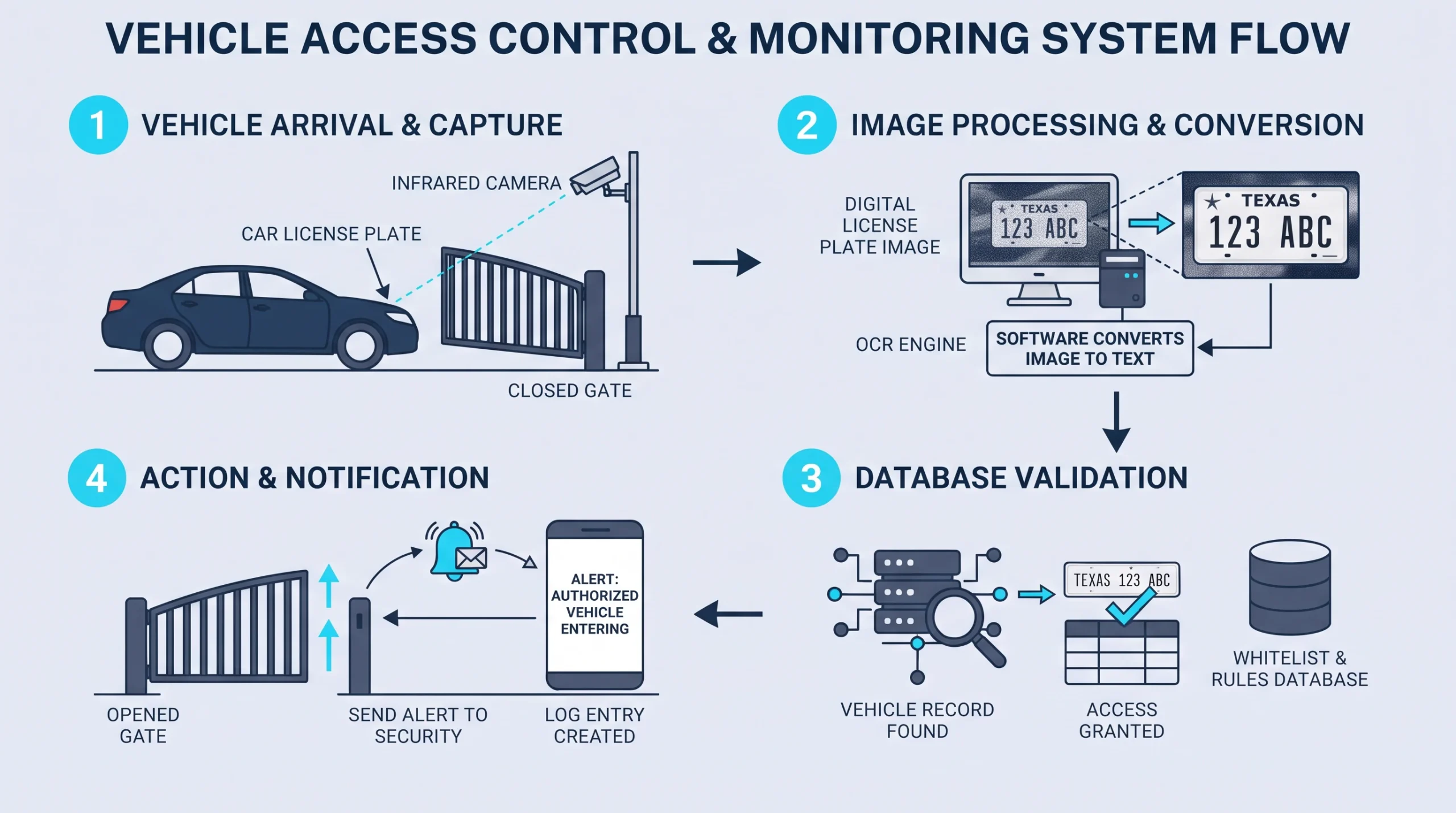
An LPR camera works in four steps. It freezes the vehicle with a fast shutter, lights the plate with infrared so it reads day or night, runs character recognition to convert the image to text, and logs the plate with a time stamp and photo in a searchable database.
Capture. A normal camera at night holds its shutter open about 1/30 of a second. A plate camera uses roughly 1/500 or faster. License plates are reflective by design, so the camera’s infrared light bounces straight back while headlight glare is filtered out.
Read. Software finds the plate in the frame and converts it to characters.
Log. Each read is stored with the time, lane and a photo, searchable by full or partial plate.
Act. A plate on your approved list can open a gate. A plate on a watch list can send an alert.
One vocabulary note. A “license plate capture” camera only takes readable pictures. “Recognition” adds the reading and the database. Sellers blur the two, so ask which one a quote includes.
Why regular parking lot cameras can’t read plates
Three reasons, and the first is arithmetic.
Not enough pixels. A Texas plate is 12 inches wide. Recognition software works best with about 100 to 150 pixels across the plate, according to Axis’s license plate capture guidance. A 4MP overview camera covering an 80-foot-wide lot puts 32 pixels on each foot of the scene. That’s 32 pixels across the plate. A 4K camera gets you 48. Neither is close.
Motion blur. At a 1/30-second exposure, a car rolling through at 15 mph moves almost 9 inches while the shutter is open. The plate smears across most of its own width.
Glare. At night, headlights overwhelm a standard camera exactly where the plate sits.
Overview cameras show what happened: the vehicle’s make and color, where it parked, what the driver did. Plate cameras answer one narrow question. A good design uses both, and our camera count and placement guide explains the pixel math for the overview side.
LPR camera system setup: the rules that decide accuracy
A camera placed by these rules at a slow choke point reads the large majority of plates. Accuracy falls with speed, steep angles, dirt, damage and tinted plate covers.
Texas removed one long-standing headache in 2025. Since July 1 of that year, dealers issue metal plates at the time of sale in place of paper temporary tags, under House Bill 718. Paper tags were the hardest thing on the road for a camera to read, and they’re now disappearing from Texas lots.
Our take: a plate camera is a one-job tool. The installs that disappoint are the ones where somebody tried to make it cover the plate and the whole entrance at once.
What businesses use LPR for
Gate and garage access. Approved plates open the gate. There are no clickers to hand out or collect, and removing a vehicle takes seconds. This is where it helps to have one company handling cameras and access control, since the plate list and the gate controller have to talk to each other.
Parking management. Know which vehicles belong to tenants, how long visitors stay, and who’s parked overnight.
Evidence. When something happens, you hand police a plate, a time and a photo.
Logistics. A yard camera time-stamps every truck in and out.
Take a medical office park off Preston Road in Plano with two driveways and a gated staff lot. Two plate cameras, one per driveway, log every vehicle entering and leaving. A third at the staff gate opens it for registered plates. The four existing overview cameras stay where they are. When a car is broken into on a Saturday, the property manager searches a two-hour window and gives police three plates with photos, not a clip of taillights. That pairing of plate cameras and overview cameras is the standard design when we scope security camera systems in Plano for properties with controlled entrances.
Not sure your entrance suits a plate camera? Send us a photo of the entrance taken from where a camera could mount. Angle and distance are usually obvious from one picture.
Is LPR legal for Texas businesses?
Reading plates on your own property is generally lawful in Texas. Plates are displayed in public view, and we know of no state statute that bars a private business from recording them. The limits are on what you do next: who installs the system, and what you can learn from a plate.
You get a plate, not a name. The federal Driver’s Privacy Protection Act bars motor vehicle agencies from releasing owner information except for a short list of permitted uses, such as court cases, insurance claims and towing notices. Curiosity about who parked in your lot isn’t on the list. You give the plate to police, and they take it from there.
The installer needs a license. A plate reader records images of vehicles and property, which puts it within the camera systems regulated by Texas Occupations Code Chapter 1702. The company selling and installing it must hold a DPS private security license. Ours is B10492801.
Write the policy first. Decide how long reads are kept, who can search them and when they’re shared. Tenants and employees will ask, and “we haven’t decided” is a poor answer. This is general information, not legal advice.
What an LPR camera system costs
In our market, expect a dedicated plate camera to run $1,200 to $3,500 for the hardware, and roughly $2,500 to $6,000 per lane installed once the mount, cable and software are included. Some plate readers are sold as a subscription instead, billed per camera per year. For the rest of the system, see our commercial camera installation cost guide.
We’d skip the “LPR mode” on a general-purpose camera as a substitute. It can work in daylight at walking speed. It’s the wrong tool at night, which is when you’ll need it.
Frequently Asked Questions
What is an LPR camera?
Can a regular security camera read license plates?
How far away can an LPR camera read a plate?
Are license plate readers legal for businesses in Texas?
One job, done right
A plate camera does one thing, and whether it does it well is decided before installation, by where it points. If you’re weighing LPR for a gate, a lot or a yard, book a free IT consultation and we’ll look at the entrance, the network and the gate hardware together.