
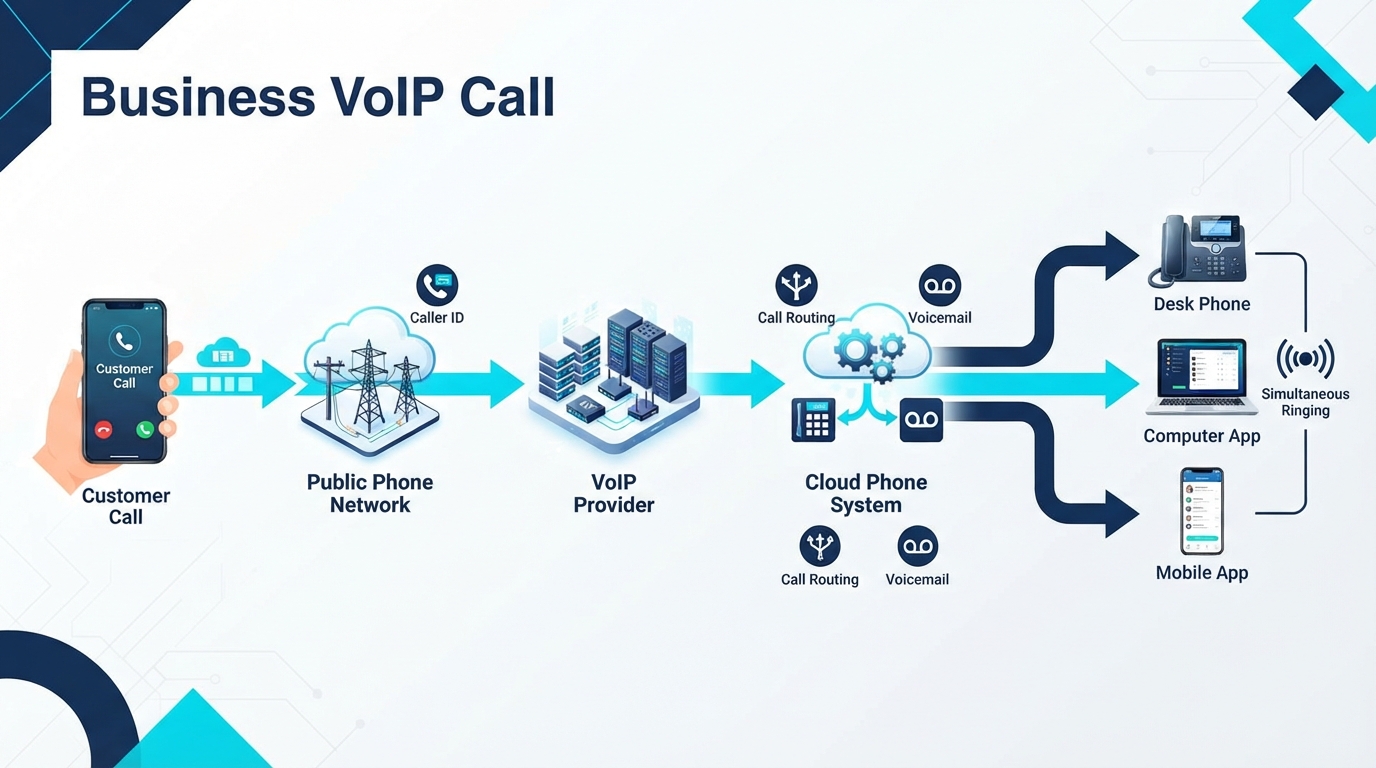
A VoIP number is a regular phone number that routes calls over the internet instead of through a dedicated copper phone line, which means it lives in software and works on any device: desk phone, computer, or the cell in your pocket. To callers, it’s indistinguishable from any other number. To the business that owns it, it behaves completely differently.
That difference is why the question comes up so often. Owners hear “VoIP number” and picture something second-class, an internet knockoff of a real phone number. It isn’t. Your bank, your doctor, and most likely the last three businesses you called are answering on VoIP numbers. Here’s what’s actually different under the hood, why it matters for a business, and the honest catches.
What is a VoIP number vs a regular number?
A traditional number is welded to a physical thing: a copper pair running to one address, terminating at one jack. The number is the wire, functionally. Move offices, and you’re begging the carrier to move it. Want it to ring in two places, and you’re buying forwarding services bolted on top.
A VoIP number is an entry in a routing database. When someone dials it, the call travels the ordinary phone network until it reaches your VoIP provider, then converts to data and delivers wherever your account says: the desk phone, the laptop app, your cell, or all three at once. The number is unbound from geography and hardware. Everything businesses like about VoIP flows from that one fact.
Practical consequences of a number living in software:
- It rings devices, plural. Desk phone and cell simultaneously, then voicemail-to-email if nobody picks up.
- It moves when you move. New office, same number, zero carrier drama. Take the whole system home during an ice storm week and it works from there.
- Area codes are a choice. A Waco company can hold a 254 number for local presence and a 214 number for its Dallas customers, both answered by the same person at the same desk.
- It scales like software. Adding line 11 is a checkbox and a monthly fee, not a construction visit.
And a right worth knowing: your existing number can come with you. FCC rules give you the ability to port your number between providers, including from a landline carrier to a VoIP service (FCC). Nobody loses the number the customers have memorized. Porting is routine; we do it weekly.
What is a VoIP caller?
A “VoIP caller” is just someone calling you from a VoIP number, and the label mostly appears on caller ID when the carrier can’t pull a name for the number. It doesn’t mean spam by itself, though scammers do favor cheap disposable VoIP numbers, which is why the label picked up a bad reputation. For a business this has a real implication in reverse: if your outbound calls show “VoIP Caller” instead of your company name, answer rates drop. The fix is proper caller ID registration (CNAM) and attestation through your provider, a ten-minute setup task that a surprising number of providers never mention. Ask for it by name.
What does a VoIP number cost?
For business service in our market, expect $15–$35 per user per month depending on features, with the number itself usually included. Compare that against $40–$70 per line for traditional business copper, before long-distance and before the feature add-ons VoIP includes by default (auto-attendant, voicemail transcription, call recording, mobile apps). Extra standalone numbers, like that second area code, typically run $5–$10 monthly each. Toll-free numbers add per-minute costs. If you’re pricing a full switch, the VoIP vs landline math deserves its own read, because the equipment side has nuances the per-line price hides.
Our take: the per-user price is real, but the reason businesses actually switch is rarely the invoice. It’s the Monday one of your people is home with a sick kid and answers the main line from the kitchen like nothing’s different. Flexibility is the product. Savings are the excuse the spreadsheet needed.
The honest catches
Three things the sales pitches skip, from the people who fix them.
Your internet is now your phone line. Internet down means phones down, unless calls fail over to cell apps, which is configurable and should be configured on day one. Ask us how many providers set it up unprompted. (Few.)
Call quality reflects network quality. A VoIP call on a congested, unmanaged network sounds like a robot in a rainstorm. The cure is boring: sufficient bandwidth and a router that prioritizes voice traffic. This is where having one team run both the phones and the network stops being a slogan; when the phones stutter, there’s no finger-pointing between a phone vendor and an IT vendor, because we’re both.
911 needs your attention. A number that isn’t tied to an address means emergency services need to be told where you are. Federal law now requires multi-line phone systems to support direct 911 dialing and to deliver a dispatchable location with the call (Kari’s Law and RAY BAUM’S Act, FCC). A properly configured business system handles this per-device, including for the remote worker’s laptop app. An improperly configured one sends the ambulance to the office while you’re home. We treat 911 location setup as a go-live checklist item, not an FAQ answer.
If it were our building: we’d port the main number to VoIP, keep it registered with proper caller ID, configure cell failover and per-device 911 the same afternoon, and put the office on a router that knows voice packets come first. That’s the whole difference between VoIP that feels like magic and VoIP that generates support tickets.
Who’s actually switching, and why
The pattern in our service area is consistent: the trigger is rarely curiosity and usually an event. The copper contract renews at a higher rate. The office moves. A storm knocks the building offline for two days and the owner discovers forwarding can’t be changed remotely. A field-service company out in Waco came to us after exactly that second scenario, mid-move, quoted six weeks by the incumbent carrier to relocate four lines. We ported the numbers to business VoIP phone service, and the phones were answering at the new location before the furniture arrived, ringing on cells in the meantime. That company now runs its whole stack through our IT support in Waco team, phones included, which is the one-roof point made without the brochure.
Curious how the plumbing works underneath, codecs and SIP and all? That’s our full guide to how VoIP works, written for owners rather than engineers.
Frequently Asked Questions
What is a VoIP number used for?
Can you call a VoIP number from a regular phone?
Does a VoIP caller mean spam?
Can I keep my business number if I switch to VoIP?
How much does a VoIP number cost?
Want to know what porting your number and switching would look like for your office, in real numbers? Talk to our business VoIP phone service team and we’ll map it with no pressure and no exclamation points.