
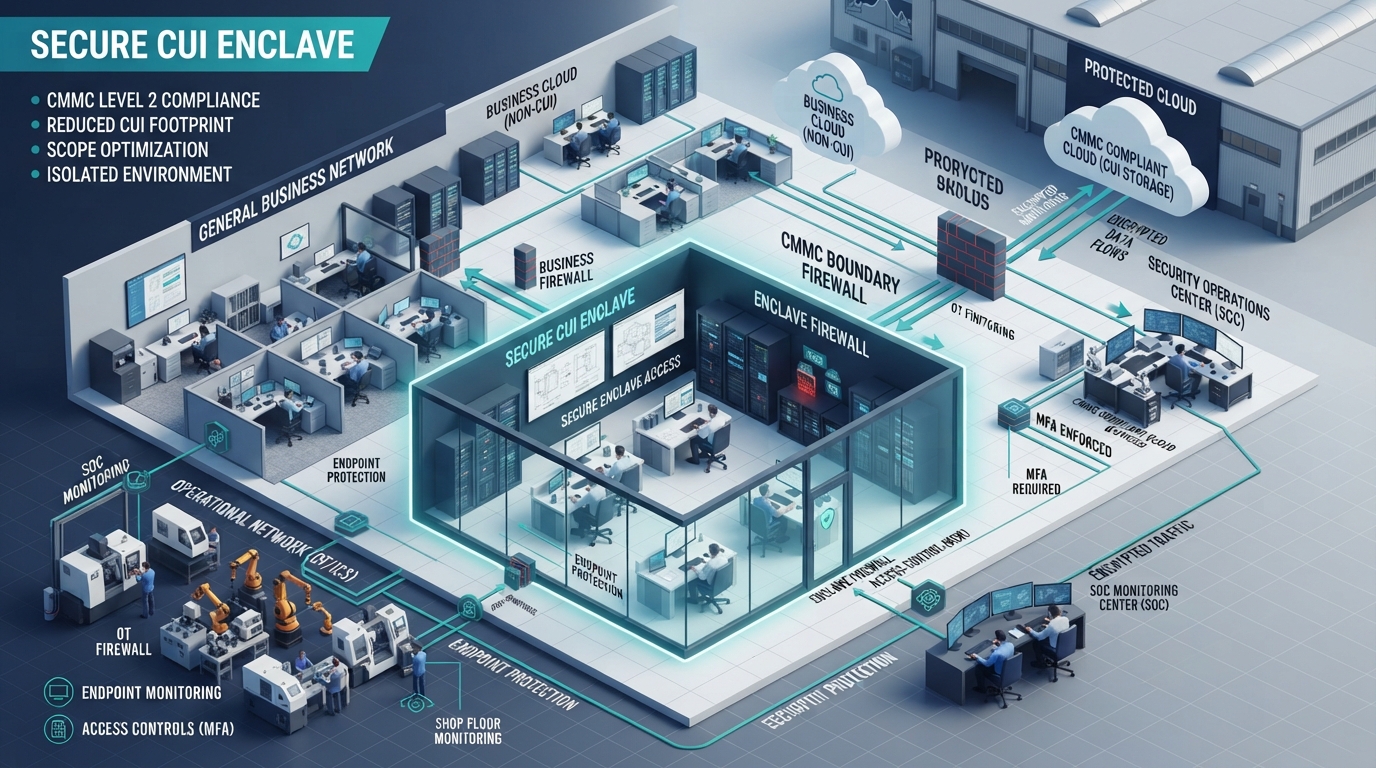
CMMC compliance means proving your company meets the Department of Defense’s cybersecurity standards before you can win or keep contracts that involve federal contract information or controlled unclassified information (CUI). The program’s final rule (32 CFR Part 170) took effect December 16, 2024, and assessment requirements are now phasing into DoD contracts. If defense work is in your revenue mix, this is no longer a someday problem.
DFW sits in one of the densest defense corridors in the country. Lockheed Martin in Fort Worth, Bell in Fort Worth and Arlington, Raytheon operations across the metroplex, and around them thousands of machine shops, harness builders, electronics houses, and logistics firms holding subcontracts and purchase orders. Most of those companies are exactly the size CMMC hits hardest: 10 to 200 employees, no compliance department, and a prime contractor now emailing questionnaires about their SPRS score. This guide is for them. Plain English, real numbers, no panic-selling.
What is CMMC, and why does it exist?
CMMC (Cybersecurity Maturity Model Certification) is the DoD’s answer to a decade of defense-industrial-base data walking out the door. Contractors have been contractually required to protect sensitive unclassified data since the DFARS 252.204-7012 clause (acquisition.gov) started appearing in contracts, and to implement the 110 security requirements of NIST SP 800-171 (NIST). The problem was enforcement: it ran on self-attestation, and self-graded homework produced predictable results.
CMMC changes the enforcement, not really the homework. The security requirements are still fundamentally NIST 800-171. What’s new is verification: depending on the data you handle, you’ll either self-assess annually with an executive signing on the line, or pass a third-party assessment before award. The program rule at 32 CFR Part 170 (eCFR) phases these requirements into contracts over roughly a three-year rollout that began when the companion acquisition rule started placing CMMC clauses in solicitations in 2025. Translation for a shop owner: every renewal cycle from here forward, more of your contracts will carry it.
CMMC levels explained
Three levels, and the data you touch decides which one applies to you:
| Level | Who it applies to | Requirements | Assessment |
|---|---|---|---|
| Level 1 | Companies handling only federal contract information (FCI) | 15 basic safeguarding requirements | Annual self-assessment + executive affirmation |
| Level 2 | Companies handling CUI (most manufacturing subcontractors with drawings/specs) | All 110 NIST SP 800-171 requirements | Third-party (C3PAO) assessment for most; self-assessment for a limited subset of contracts |
| Level 3 | Companies supporting the most critical programs | Level 2 plus selected NIST SP 800-172 enhanced requirements | Government-led assessment |
The population math is what matters locally. The overwhelming majority of DFW subcontractors land at Level 1 or Level 2, and the expensive question is almost always the same one: do you actually handle CUI? If a prime sends you controlled technical drawings, ITAR-marked specs, or export-controlled data to quote or build against, you’re in Level 2 territory. If you sell them commercial off-the-shelf hardware or janitorial services against a PO, you may be Level 1. Getting this scoping question answered correctly, in writing, with your primes, is worth more than any single piece of security software you’ll buy, because the compliance cost difference between the levels is roughly an order of magnitude.
The core CMMC requirements at Level 2
The 110 NIST 800-171 requirements span 14 control families, but on real shop floors the work concentrates in a recognizable handful:
Access control and MFA. Named accounts for every user, least-privilege permissions, multi-factor authentication on network and privileged access. The shared “SHOP” login on the machine at the end of the line is the first finding of nearly every gap assessment we run.
Knowing where CUI lives, and shrinking that footprint. You can’t protect data you can’t locate. The single highest-value move for a small contractor is an enclave: confining CUI to a defined, hardened environment (often Microsoft 365 GCC High or a segregated system) instead of trying to certify every laptop, phone, and the front-desk PC. Scope is cost. Shrink the scope.
Audit logging. Systems must record who did what, and someone must be able to produce and review those logs. “The system probably logs that” is not a passing answer.
Incident response and reporting. DFARS 7012 requires reporting cyber incidents to the DoD within 72 hours of discovery, which is a much shorter clock than most commercial obligations and requires having a plan before the incident.
Configuration and patch management, media protection, physical security, training. Documented baselines, controlled USB use, visitor controls in areas where CUI is visible (yes, drawings pinned above a workbench count), and recurring awareness training with records.
Two artifacts hold all of it together: the System Security Plan (SSP), which documents how you meet each requirement, and the POA&M (plan of action and milestones) for the limited set of items you’re still closing. Your self-assessment score against the 110 requirements gets posted to the DoD’s SPRS database, and primes check it. An honest low score with a credible POA&M beats a fictional 110, and not just ethically: false claims about compliance are False Claims Act territory, and the Department of Justice has been actively pursuing exactly those cases under its civil cyber-fraud enforcement.
What does CMMC compliance cost?
Ranges, framed honestly, for what we see in this market. Your scoping decisions swing these more than any vendor choice:
| Item | Level 1 | Level 2 (enclave approach) |
|---|---|---|
| Gap assessment | $2,000–$7,500 | $7,500–$25,000 |
| Remediation (tools, enclave setup, documentation) | $5,000–$20,000 | $40,000–$150,000+ |
| C3PAO third-party assessment | Not required | $30,000–$60,000 typical for small orgs |
| Ongoing compliance operations | $500–$1,500/mo | $2,000–$6,000/mo |
Those Level 2 numbers make owners flinch, so two honest framings. First, the enclave approach is the entire reason the remediation line isn’t double that; certifying a whole flat network is how six figures becomes seven. Second, weigh it against the revenue at risk. If defense work is 30% of a $6M shop, you’re weighing a one-time investment against $1.8M a year of business that will, contract by contract, become unavailable without it. Some shops legitimately decide to exit defense work instead. That’s a rational choice too, as long as it’s a choice and not a surprise at renewal.
Our take: the worst money spent in CMMC is speed-bought money. We’ve seen contractors panic-purchase compliance-in-a-box platforms that generated a beautiful SSP describing controls nobody actually implemented. An assessor reads the SSP, then checks reality. When the two don’t match, you’ve paid twice: once for the shelf-ware, once for the real work.
A realistic readiness path (and timeline)
For a typical Level 2 subcontractor starting from ordinary small-business IT, plan on 9 to 18 months end to end. The pattern that works:
- Scope first (weeks 1–4). Inventory contracts and data flows. Confirm with your primes, in writing, what’s FCI and what’s CUI. Decide the enclave boundary.
- Gap assessment against all 110 (weeks 4–8). Produce the honest scorecard and the initial SSP skeleton.
- Remediate in dependency order (months 2–9). Identity and MFA first, then the enclave migration, then logging, then the documentation and training layers. This overlaps heavily with controls you should run anyway, and with what cyber insurers separately demand, so much of the spend does double duty. The security fundamentals underneath are the same ones in the broader small business security playbook.
- Operate for a quarter before assessment (months 9–12). Assessors want evidence of controls running, not installed last Tuesday: log reviews performed, training completed, incidents drilled.
- Schedule the C3PAO early. Assessor capacity is a real constraint as demand ramps through the phase-in; booking windows stretch months out.
Here’s the composite shape of it locally. A 60-person precision machining company in Arlington, feeding parts into aerospace programs a few miles from its own building, holds CUI in the form of controlled drawings from two primes. The winning design: a 12-user CUI enclave for engineering and quoting staff on GCC High, the shop floor network segregated and out of scope, MFA and monitored endpoints across the enclave, and an SSP that describes what’s actually true. The other 48 employees’ machines never enter assessment scope. That scoping decision alone cut their projected cost roughly in half, and it’s the first thing our IT support in Arlington engineers whiteboard with any contractor who calls about a prime’s questionnaire.
If it were our building: we’d start the moment a prime first mentions CMMC, not when a solicitation requires it, because the phase-in means your certified competitors get to bid on work you can’t. And we’d treat SPRS honesty as strategy: primes are consolidating supplier lists around subs who can evidence readiness. Being provably on a credible path is already a sales asset in this metroplex, before any certificate exists.
What assessors actually ask for
Owners picture an assessment as a network scan. It’s closer to a financial audit: documents first, then proof the documents describe reality. Knowing the evidence list up front changes how you build everything, because you build it to be shown.
Expect requests shaped like these. Your SSP, current and matching the environment as it exists today, not as it existed when a consultant wrote it. Screenshots and exports proving MFA enforcement on the accounts the SSP claims, including a sample the assessor picks, not the sample you pick. Log samples with evidence someone reviews them: a recurring calendar entry and initialed review notes carry real weight. Training records with names and dates. The incident response plan plus evidence it’s been exercised, where even a one-hour annual tabletop with written notes clears the bar most small contractors miss. Access reviews showing that when the estimator left in March, his account died in March, not “probably around then.”
The pattern across all of it: artifacts of operation, not artifacts of installation. A firewall invoice proves you bought a firewall. A quarterly rule-review record proves you run one. Assessors are explicitly trained to tell the difference, which is why our readiness path parks a full quarter of normal operations between remediation and assessment. That quarter is where the evidence gets generated, and there’s no way to backfill it honestly.
For manufacturers specifically, the shop-floor wrinkles (OT equipment that can’t be patched, controlled drawings at workstations, CNC controllers older than your newest employee) deserve their own treatment, and we’ve written one.
Common mistakes we keep seeing
Waiting for “final clarity.” The program rule is final and in force; the phase-in is the clarity. Every month of waiting is a month added to a 9–18 month runway.
Certifying everything. No enclave, whole network in scope, triple the cost. Scope is the budget lever.
Confusing tools with compliance. CMMC is one-third technology, two-thirds documented, operating process. Buying software without operating discipline fails assessments.
One person owns it, then leaves. Compliance knowledge in a single head is a resignation letter away from zero. Documentation exists for this.
Forgetting flow-down. If you send CUI to your subcontractors or use external IT and cloud providers, their status becomes your problem. Ask your vendors the same questions your primes are asking you. This includes your MSP: an external provider that can touch systems processing CUI sits inside your assessment boundary, and an IT vendor who’s never heard of an SSP will cost you findings.
Treating email as out of scope. The single most common place CUI actually lives in a small shop isn’t the file server. It’s the inbox, where a prime attached the controlled drawing to an RFQ three years ago and it’s been syncing to phones ever since. If your enclave design doesn’t answer “where does CUI-bearing email land,” it isn’t a design yet. This is also the mistake that quietly puts personal devices in scope, which nobody wants.
Frequently Asked Questions
What is CMMC compliance?
Who needs to be CMMC certified?
What are the three CMMC levels?
How much does CMMC Level 2 compliance cost a small business?
How long does it take to become CMMC compliant?
Got a prime asking for your SPRS score, or a solicitation with a CMMC clause in it? Our CMMC compliance services team will scope your actual exposure, in plain English with real numbers, before you spend a dollar on remediation.