
IT Support Pricing in Texas: What Should You Actually Pay Per User?
By Raul Escalante, Texas Communication Services
In Texas, the cost of IT support services is a pivotal concern for many small to medium-sized businesses (SMBs) aiming to optimize their operational budgets without sacrificing essential technology support. Understanding the intricacies of IT support pricing can empower businesses to make informed decisions that align with their financial expectations and operational needs. This article provides a comprehensive analysis of IT support pricing in Texas, specifically focusing on per user models, which are increasingly popular among SMBs for their predictability and scalability. Moreover, we will delve into the current pricing models, the factors influencing costs, and how cloud solutions impact pricing structures.
Readers will gain insights into the various pricing tiers offered by managed service providers (MSPs) in Texas. Also, we’ll explore how regional differences, particularly in cities like Dallas and Fort Worth, can affect pricing. The article will also compare the per user pricing model to the per device model, shedding light on their unique advantages in a business context.
What Are the Current Managed IT Services Pricing Models in Texas?
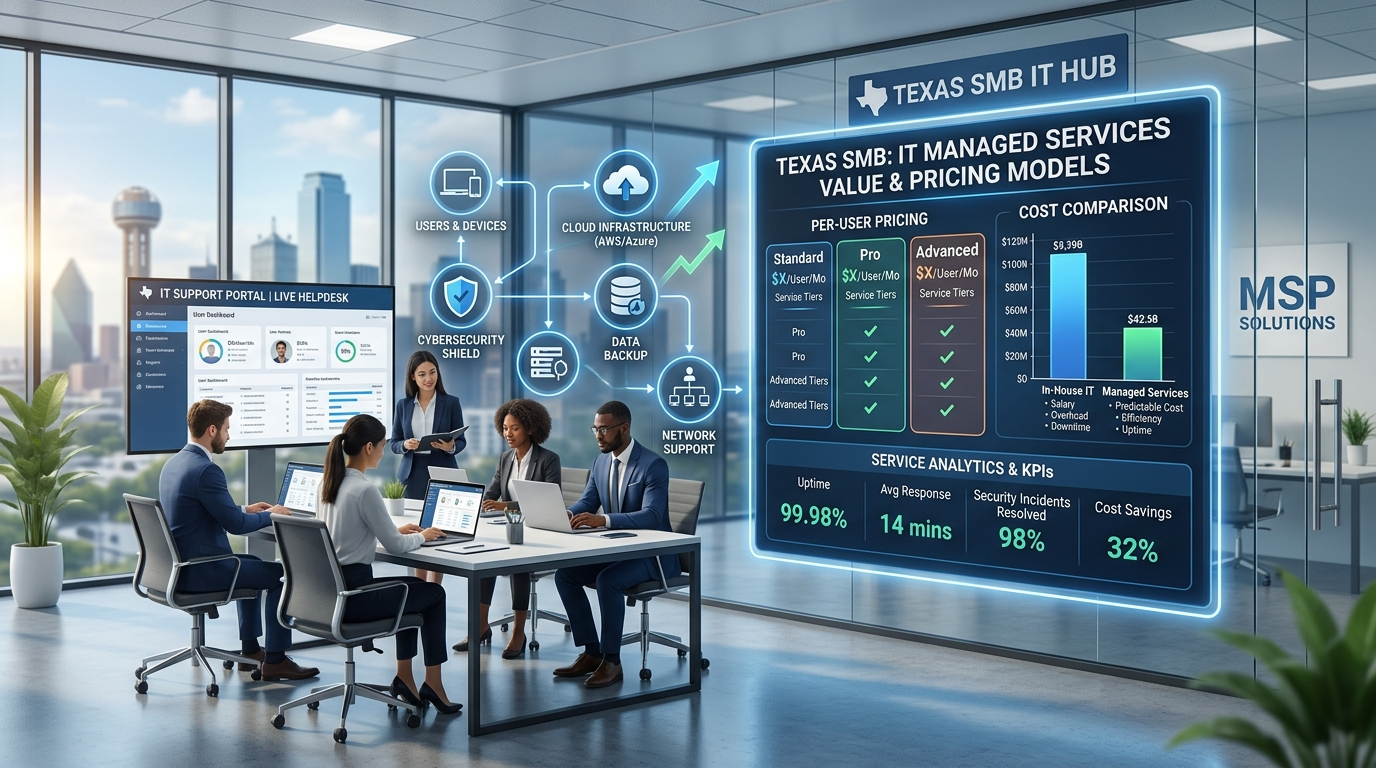
Texas has emerged as a competitive landscape for managed IT services, with multiple pricing models available for businesses looking to outsource their IT infrastructure management. A commonly adopted model is the per user pricing, which typically includes fixed monthly fees covering support, maintenance, and monitoring services. This model enables predictability in budgeting, which is crucial for SMBs that may have limited IT budgets.
Alongside the per user model, other pricing structures exist, including:
| Pricing Model | Characteristics | Best For |
|---|---|---|
| Per User | Fixed monthly fees based on the number of users. Often includes comprehensive services. | SMBs prioritizing budget control |
| Per Device | Monthly fees based on the number of devices supported. Allows scalability with device count. | Companies with varying devices |
| Tiered Pricing | Different service levels offered at escalating price points, allowing customization based on needs. | Businesses with diverse needs |
These pricing models are designed to accommodate diverse business requirements, thus providing flexibility and tailored solutions that enhance operational efficiency.
How Does the Per User Pricing Model Work for Texas SMBs?
The per user pricing model is particularly beneficial for Texas SMBs as it offers a predictable cost structure. This model helps businesses avoid fluctuating expenses, enabling them to allocate resources more effectively. Typically, this model encompasses all aspects of IT support, including help desk assistance and infrastructure management. It allows for streamlined communication with service providers, eliminating unexpected costs that can arise with per device models.
Additionally, per user pricing facilitates scalability, allowing businesses to easily add new users to their IT support contract without significant renegotiation. This adaptability ensures that as businesses grow, their IT infrastructure can be adjusted accordingly without financial strain.
What Are Common Service Tiers Offered by Texas MSPs?
Managed service providers in Texas often offer various service tiers within their pricing models. These tiers provide different levels of support, features, and response times to accommodate varying business needs. Common tiers include:
- Basic Support: Typically offers essential troubleshooting and support, suitable for smaller operations with limited IT requirements.
- Standard Support: Includes proactive monitoring, regular maintenance, and improved response times, ideal for growing SMBs.
- Premium Support: Provides comprehensive IT solutions, including advanced security features and dedicated account management, designed for businesses that depend heavily on technology.
In addition to defining service capabilities, each tier usually has corresponding price points, enabling businesses to select the level of service that best fits their budget and requirements.
Which Factors Influence the Cost of IT Support Per Employee in Texas?
Several factors play a crucial role in determining the cost of IT support services for Texas businesses. These include:
- Service Levels: Higher levels of service often translate to higher costs. Premium support may involve 24/7 availability and faster response times.
- Technology Type: The complexity of the technology used can influence pricing. More sophisticated infrastructure may incur higher support costs.
- Provider Reputation: Established providers with a history of reliability and quality service may command higher fees than newer or less reputable businesses.
Understanding these pricing influences helps businesses tailor their IT support contracts to their specific operational needs and financial capacities.
How Do Cloud Solutions and Security Add-Ons Affect Pricing?
Cloud solutions and security add-ons are increasingly important components of IT support, impacting overall pricing structures significantly. Many Texas businesses are adopting cloud services for data storage and management, which can lead to variable costs depending on usage patterns. Security add-ons, such as malware protection and intrusion detection systems, are integral to safeguarding business operations but can also contribute significantly to monthly fees.
For example, integrating a robust cybersecurity package could add an average of $20 to $50 per user to monthly IT support costs. This investment, while increasing immediate expenditures, can prove to be cost-effective in preventing data breaches and potential financial losses.
SMB Cybersecurity: Balancing Cost & Coverage with MDR Services
Small and medium-sized businesses (SMBs) represent over 90% of enterprises globally, yet they are disproportionately underserved in cybersecurity due to budget limitations, resource constraints, and the growing sophistication of threats. While Managed Detection and Response (MDR) services have emerged as a crucial security lifeline for these organizations, designing a profitable, scalable, and always-on 24/7 MDR model tailored to SMBs presents unique challenges. These include balancing operational costs with service coverage, leveraging automation while ensuring human-in-the-loop oversight, and designing modular yet cost-effective threat detection capabilities. MDR service design: Building profitable 24/7 threat coverage for
SMBs, PR Rajgopal, 2025
What Regional Elements Impact Pricing in Dallas and Fort Worth?
The geographic location of a business within Texas can also affect IT support pricing. For instance, businesses located in more urban settings like Dallas might experience different rates compared to those in Fort Worth due to demand levels and operational costs associated with city infrastructure.
- Local Demand: Higher concentrations of businesses in urban areas can drive competition among IT service providers, impacting pricing structures.
- Operational Costs: Differences in the cost of living between regions can also result in varying pricing for comparable IT services.
Such regional elements illustrate the importance of thorough market research when selecting an MSP.
How Does Per User Pricing Compare to Per Device Pricing for Texas Businesses?
Texas businesses often face the decision between per user and per device pricing models for IT support. Each approach has distinct advantages based on business needs and operational structure.
What Are the Advantages of Each Pricing Model for SMBs?
- Per User Pricing: Budget Predictability: Simplifies financial planning with fixed monthly charges.Holistic Coverage: Often includes a comprehensive range of services and support.Flexibility: Easily scalable as new employees are added.
- Per Device Pricing: Pay for What You Use: Potentially lower costs for businesses with minimal technology.Customized Support: Supports specific devices or technological needs without a blanket approach.Focus on Hardware: Businesses with distinct hardware needs can tailor their services accordingly.
Both models have their merits, but understanding each’s implications helps SMBs make informed decisions aligned with their operational goals.
Which Pricing Option Offers Greater Cost Transparency and Scalability?
In general, the per user model tends to offer greater cost transparency for SMBs as it allows businesses to clearly anticipate monthly expenses. This model supports easy scaling since adding new users involves straightforward adjustments to the monthly fees, thus promoting seamless technology management. Conversely, while per device pricing can provide cost benefits in certain scenarios, it may introduce unpredictability in costs if device counts fluctuate significantly, which can complicate budgeting.
What Are Typical MSP Rates in Fort Worth and Dallas for Managed IT Support?
When examining MSP rates in Fort Worth and Dallas, businesses can generally expect to encounter an average range for managed IT support services. Based on current research, the typical rate for per user pricing as of 2023 is approximately:
- Basic Plans: $80 – $100 per user per month
- Standard Plans: $100 – $150 per user per month
- Premium Plans: $150 – $300 per user per month
Pricing can vary based on the specific features offered, level of service, and the provider’s reputation.
What Are 2023 Industry Benchmark Costs for IT Support Per User?
In 2023, industry benchmarks indicate that businesses in Texas can expect varying costs across different service levels. These benchmarks serve as important guidelines for evaluating potential providers:
| Service Level | Average Monthly Cost Per User | Common Features |
|---|---|---|
| Basic | $80 – $100 | Essential support and monitoring |
| Standard | $100 – $150 | Proactive maintenance and updates |
| Premium | $150 – $300 | Comprehensive security and support |
This structured overview highlights the importance of aligning service selections with budget realities while ensuring appropriate coverage and responsiveness.
How Do Service Features Correlate With Price Variations?
As businesses consider the structure of their IT support agreements, it is essential to recognize the correlation between service features and pricing variations. More robust service offerings typically attract higher fees due to the added value they deliver, such as:
- Advanced Security Features: Enhanced protection measures increase delivery costs.
- Dedicated Account Management: Personalized service can drive prices higher due to the dedicated resources involved.
- Comprehensive Support: Inclusive services that cover a range of IT needs naturally incur higher rates.
Selecting the right mix of features thus requires careful consideration of costs versus operational priorities.
How Can Texas SMBs Benefit From Transparent IT Support Pricing?
Transparent IT support pricing models can significantly benefit Texas SMBs by creating predictability and clarity in financial planning. By knowing the monthly costs upfront, businesses can invest confidently in technology without worrying about unexpected expenses or hidden fees.
What Should You Expect in a Personalized IT Support Contract?
When engaging with an MSP, it’s crucial to expect a well-structured and transparent contract outlining all terms and service details, including:
- Comprehensive Pricing: Clearly defined fees associated with different service levels.
- Service Level Agreements (SLAs): Specific commitments regarding response times and service delivery.
- Contract Flexibility: Options for adjusting services according to the changing needs of the business.
These elements ensure that businesses can anticipate their IT costs effectively, enabling better budgeting and resource allocation.
How Do Case Studies Demonstrate Cost Savings and Enhanced Support?
Real-world case studies underscore the advantages of adopting transparent IT support pricing models. Many Texas SMBs have reported:
- Significant Cost Reductions: By transitioning to a per user pricing model, businesses can achieve notable savings.
- Improved Service Delivery: Enhanced support structures result in better operational performance and reduced downtime.
These insights highlight the benefits that can be realized through effective planning and service provider alignment.
What Frequently Asked Questions Do Texas Businesses Have About IT Support Pricing?
Understanding common inquiries can illuminate crucial aspects of IT support pricing structures.
What Is the Average IT Support Cost Per User in Texas?
The average IT support cost per user in Texas generally ranges from $80 to $150, depending on service features and provider choice. This data offers a useful baseline for businesses assessing their options.
Are There Hidden Fees or Flexible Contract Options?
Texas SMBs should be wary of potential hidden fees within contracts, a common concern among clients. Transparent providers should clearly indicate any additional costs related to overages or extra support. Flexibility within contract terms is also essential, allowing businesses the latitude to adapt their agreements as their needs evolve.
By understanding these common questions, businesses can better navigate the landscape of IT support pricing, ensuring they secure the best value for their operational investments.