
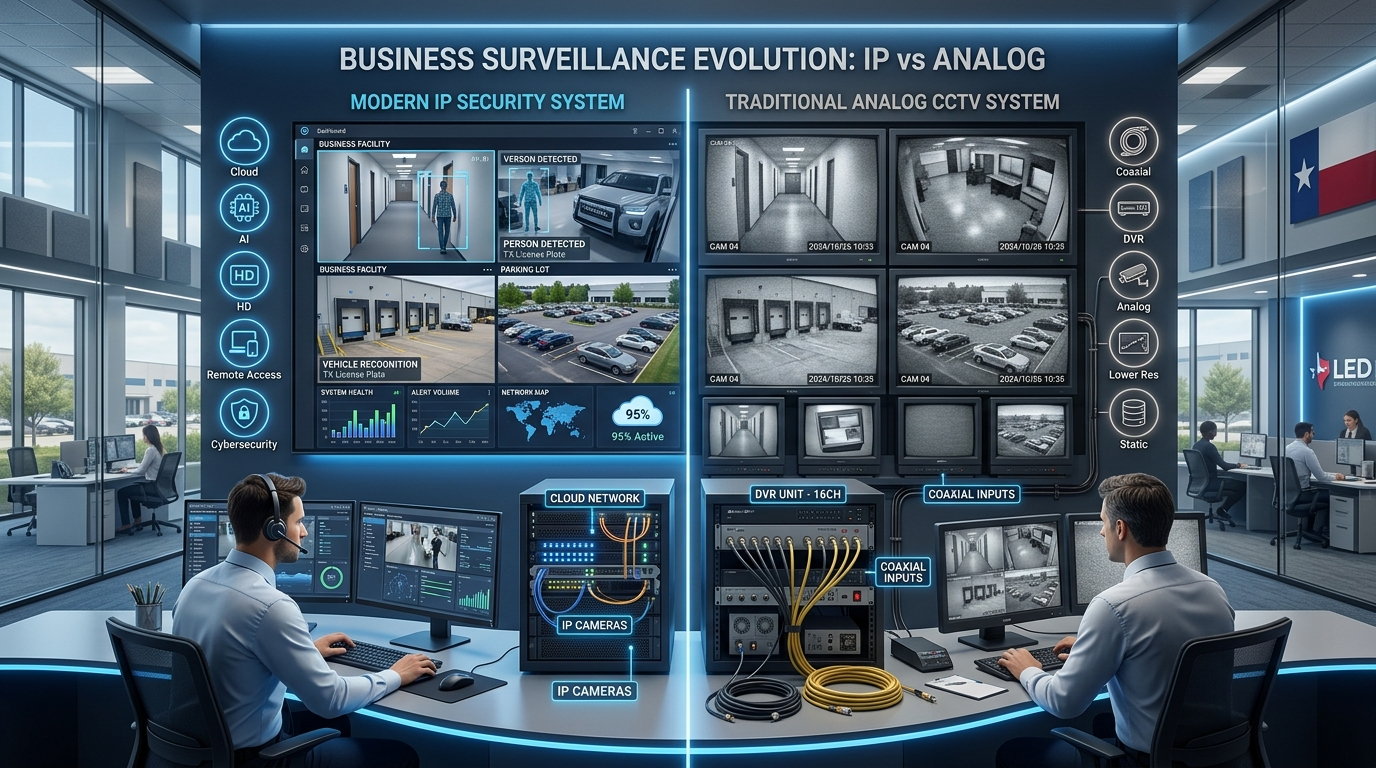
IP vs. Analog Business Security Cameras: Choosing the Right System for Your Facility in Texas
By Raul Escalante, Texas Communication Services
In the rapidly evolving landscape of security technology, the decision between IP and analog business security cameras is crucial for effective surveillance. This article aims to guide you through the nuances between these two systems, focusing on their costs, image quality, installation processes, and tailored security needs. IP cameras, known for their advanced features and connectivity options, offer significant benefits, while analog systems may still serve certain facilities well due to their simplicity and cost-effectiveness. By delving into these differences, you will gain insights into making an informed choice that aligns with your business’s security requirements. Key sections will cover comparative costs, essential features of each camera type, scalability, and professional support options to help you navigate this critical decision.
Cost
Understanding the cost implications of IP vs. analog security cameras is essential for making a suitable investment. IP systems typically involve higher initial costs due to the advanced technology they employ, but they can lead to savings in the long run. This comparison highlights the major factors to consider when evaluating your options.
| Camera Type | Initial Cost | Long-term Maintenance Cost | Scalability Costs |
|---|---|---|---|
| IP Cameras | Higher investment | Generally lower | Easily scalable |
| Analog Cameras | Lower investment | Potentially higher | Limited scalability |
The investment in IP cameras is often justified by their technological advantages, such as clearer image quality and advanced features like remote monitoring, which can lead to cost savings over time. Conversely, while analog cameras may have lower upfront costs, potential maintenance and limited scalability could outweigh these benefits in certain business scenarios.
Image Quality
Image quality is a critical aspect of security systems, directly impacting the effectiveness of surveillance operations. IP cameras tend to provide superior resolution and video clarity compared to their analog counterparts. This difference is crucial for identifying individuals and incidents clearly.
IP cameras boast high-resolution capabilities, enabling detailed images that enhance identification processes. Furthermore, they adapt well to varying environmental conditions, offering consistent performance in different lighting and weather situations. Analog cameras, while adequate in specific contexts, may struggle to offer the same level of clarity, especially in more demanding environments.
Installation Requirements
When deciding on a surveillance system, installation requirements should be considered, as the complexity can impact overall efficiency and effectiveness. The wiring and setup processes for both camera types differ significantly.
- IP Cameras: Generally require an existing network infrastructure and may need specialized equipment for installation. These cameras can be more complex to set up, especially with remote access features.
- Analog Cameras: Offer a simpler installation experience but often rely on traditional wiring, which could limit flexibility in camera placement.
This distinction points to the need for businesses to evaluate their current infrastructure and installation capabilities before making a decision.
Specific Security Needs
Identifying your specific security requirements is crucial when choosing between IP and analog cameras. Each camera type addresses different needs depending on the operational environment and the desired security features.
For example, IP cameras are ideally suited for environments where high-resolution imaging and remote monitoring are priorities. They enable advanced functionalities such as motion detection and video analytics, which can enhance overall security strategy. Conversely, analog cameras may meet the basic security needs of facilities that do not require complex features or extensive surveillance coverage.
Texas Communication Services can assist businesses in identifying their unique security requirements and recommending tailored solutions that align with their needs.
Future Growth and Scalability
Scalability is vital for businesses anticipating future expansion or changes in security needs. IP camera systems generally provide greater scalability, allowing for easy addition of cameras and features without significant overhauls to existing setups.
Analog systems, while initially less expensive, often face limitations when it comes to expanding coverage or upgrading capabilities. This aspect could potentially lead to higher costs in the long run as businesses evolve and their security needs change.
Compliance and Storage Requirements
Compliance with industry regulations is crucial for security systems, impacting both the selection of cameras and data storage solutions. IP systems typically offer more flexible options for data storage, such as cloud solutions, which can facilitate meeting regulatory requirements effectively.
Analog systems may involve traditional storage methods, which could pose challenges for compliance depending on the data’s sensitivity and the industry regulations governing it. Businesses should evaluate compliance needs along with technological capabilities when choosing between systems.
Professional Assessment
For optimal system selection, a professional assessment is recommended. Engaging with experts can lead to tailored recommendations based on a thorough evaluation of your facility’s needs. Texas Communication Services specializes in providing this type of consultation, ensuring businesses select the most appropriate security solutions.
Benefits of consulting experts include:
- Customized Recommendations: Addressing specific security needs and requirements.
- Technical Evaluation: Assessing existing infrastructure for compatibility with proposed systems.
- Installation Insights: Understanding installation complexities of both camera types.
What Are the Key Differences Between IP and Analog Security Cameras?
The primary distinctions between IP and analog security cameras include their technological foundations, cost structures, image quality, and adaptability to various security needs.
- IP Cameras: Leverage digital technology for higher resolution, advanced analytics, and flexible storage solutions.
- Analog Cameras: Use older technology providing lower resolution but potentially simpler installation and lower initial costs.
Evaluating these differences allows businesses to make informed decisions regarding their security setups, aligning features with operational needs.
How Do IP Security Cameras Enhance Business Surveillance Systems?
IP security cameras enhance business surveillance by offering advanced technological features such as high-definition video, remote access capabilities, and integration with other security systems. Their ability to provide real-time alerts and motion detection significantly improves overall security measures within a facility.
The integration of IP cameras with cloud storage further optimizes data management, facilitating easier compliance with data regulations and enhancing data accessibility.
What Are the Limitations of Analog CCTV for Commercial Use?
Despite certain advantages, analog CCTV systems also present specific limitations:
- Resolution Constraints: Lower image quality affects the ability to identify individuals accurately.
- Scalability Issues: Adding cameras can be cumbersome and often requires extensive rewiring.
- Limited Features: Many advanced analytics and remote monitoring features are simply not available.
These limitations may impact the effectiveness of surveillance for businesses requiring robust security solutions.
How Does Network Infrastructure Impact IP Camera Installation for Texas Businesses?
The installation of IP cameras is heavily influenced by the existing network infrastructure within a facility. A robust and reliable network ensures effective communication between cameras and monitoring systems, preventing data loss or connectivity issues.
Businesses must assess their current networking capabilities to guarantee that they can support the bandwidth and performance requirements of IP cameras.
What Network Requirements Support Reliable IP Business Security Cameras?
To ensure reliable performance of IP business security cameras, certain network requirements must be met:
- Adequate Bandwidth: Sufficient bandwidth to support high-resolution video streaming.
- Stable Connectivity: Consistent network connection to minimize disruptions.
- Security Protocols: Implementation of cybersecurity measures to protect against unauthorized access.
Meeting these requirements helps maximize the effectiveness and reliability of IP surveillance systems.
How Can Cloud Integration Improve Remote Monitoring and Data Storage?
Integrating cloud solutions allows for enhanced remote monitoring and data management of surveillance systems. This technology offers several advantages, such as:
- Accessibility: Users can access footage from multiple devices, enhancing security management.
- Scalability: Easily increase storage capacity to accommodate growing data needs without significant investments in physical storage.
- Data Protection: Cloud solutions often provide robust protections against data loss.
These aspects make cloud integration an appealing option for businesses looking to enhance their surveillance capabilities.
What Are the Cost Factors and ROI of Installing IP versus Analog Security Cameras?
Several cost factors influence the return on investment (ROI) for installing either IP or analog security cameras. Initial costs, long-term maintenance, and potential savings from enhanced security measures must be considered.
Businesses should analyze their security budgets, assessing the value derived from each system type based on surveillance needs and feature requirements.
How Do Installation and Maintenance Costs Compare for IP and Analog Systems?
When comparing installation and maintenance costs between IP and analog systems, several factors should be recognized:
- Installation Complexity: IP systems tend to require more technical installation, which can increase upfront costs.
- Maintenance Needs: Analog systems often entail higher ongoing maintenance due to outdated technology and equipment.
Understanding these cost dynamics is crucial for making a financially sound decision regarding security systems.
What Are the Long-Term Benefits of IP Cameras for Business Security Investments?
The long-term benefits of IP cameras include enhanced image quality, scalability, and advanced features. Businesses investing in IP technology can expect improved security outcomes, which translate to better protection of assets and personnel.
Furthermore, the ability to easily integrate additional capabilities into an IP system supports businesses as they evolve, ensuring they can adapt to new security challenges over time.
Which Commercial Security Camera Installation Services Does Texas Communication Services Provide?
Texas Communication Services offers a comprehensive range of installation services tailored to meet the specific security needs of businesses. Our expertise includes assessing facility requirements, recommending appropriate camera types, and ensuring effective installations that align with compliance and operational needs.
This hands-on support ensures businesses receive not only the technology but also the tailored guidance necessary to maximize their surveillance effectiveness.
How Does Texas Communication Services Ensure Secure IP Camera Deployment?
Ensuring the secure deployment of IP cameras involves numerous measures, such as:
- Network Security Assessments: Analyzing existing infrastructure for potential vulnerabilities.
- Implementation of Robust Security Protocols: Protecting against unauthorized access and data breaches.
- Ongoing Maintenance: Providing support to ensure systems remain secure and functional.
These practices allow Texas Communication Services to provide high-quality security solutions that businesses can trust.
What Support and Maintenance Options Are Available for Business Security Systems?
Effective support and maintenance are vital for the long-term functionality of security systems. Texas Communication Services offers several options:
- Regular System Audits: Ensuring systems are up-to-date and functioning optimally.
- Technical Support Services: Addressing issues as they arise, minimizing downtime.
- Upgrading Options: Providing insights into enhancing existing systems without needing complete overhauls.
These services ensure that businesses can maintain the integrity and effectiveness of their security operations.
What Use Cases Demonstrate the Effectiveness of IP vs. Analog Cameras in Texas Facilities?
Various use cases highlight the effectiveness of IP and analog cameras based on facility-specific needs:
- Retail Environments: High-resolution IP cameras can deter thefts and provide valuable evidence through detailed footage.
- Industrial Sites: Analog cameras may suffice where monitoring is limited and costs need to be minimized.
- Office Buildings: IP systems support remote monitoring and are ideal for ensuring employee safety.
These contexts illustrate how specific environments dictate the choice between IP and analog systems.
Which Facilities Benefit Most from IP Security Camera Features?
Facilities with significant surveillance needs or those requiring high-quality footage will benefit most from IP camera features. Environments like:
- Banks: Require detailed video for security and compliance.
- Healthcare Facilities: Value advanced monitoring capabilities for patient safety and compliance.
- Large Retail Chains: Benefit from remote monitoring and analytics to improve loss prevention.
These sectors illustrate the enhanced security capabilities offered through advanced IP camera systems.
When Is Analog CCTV Still a Viable Option for Business Security?
Analog CCTV remains a viable option for businesses with more straightforward security needs. Entities may consider analog systems in scenarios like:
- Small businesses that require minimal surveillance.
- Facilities with budget constraints that prioritize initial savings over advanced features.
- Organizations with longstanding operational setups that seek to maintain consistency without major upgrades.
In these cases, analog cameras can effectively meet security expectations, albeit with recognized limitations.
What Are the Latest Security and Technology Trends Influencing Business Surveillance Choices in 2026?
Staying abreast of trends is essential for selecting the right security systems. Recent developments impacting business surveillance choices include:
- Integration with IoT: The shift towards interconnected devices enhances surveillance capabilities.
- Advancements in AI: AI technology is driving innovations in analytics and threat detection for security systems.
- Cloud Solutions: Increasing reliance on cloud technologies improves data management and compliance.
These trends are shaping the landscape of business surveillance, necessitating ongoing evaluation of security strategies and technologies.
How Do Cybersecurity Protocols Enhance Network Cameras for Business Use?
Cybersecurity protocols play a vital role in ensuring the safety and functionality of network cameras. Implementing strong cybersecurity measures can:
- Protect against unauthorized access and data breaches.
- Maintain the integrity of video footage and system operations.
- Ensure compliance with data protection regulations.
These protocols are essential for maximizing the effectiveness of IP camera systems and enhancing overall surveillance security.
What Market Growth Trends Are Driving IP Camera Adoption in Texas?
The adoption of IP cameras in Texas is being driven by significant market growth trends, including:
- Increased Demand for Advanced Surveillance: Businesses seeking enhanced security capabilities are leaning towards IP solutions.
- Cost Efficiency: As technology advances, the cost of IP cameras continues to decrease, making them more accessible.
- Regulatory Compliance Needs: Growing industry regulations necessitate improved data handling and storage solutions.
These factors collectively contribute to a shifting preference towards IP cameras, underscoring their relevance in contemporary security strategies.