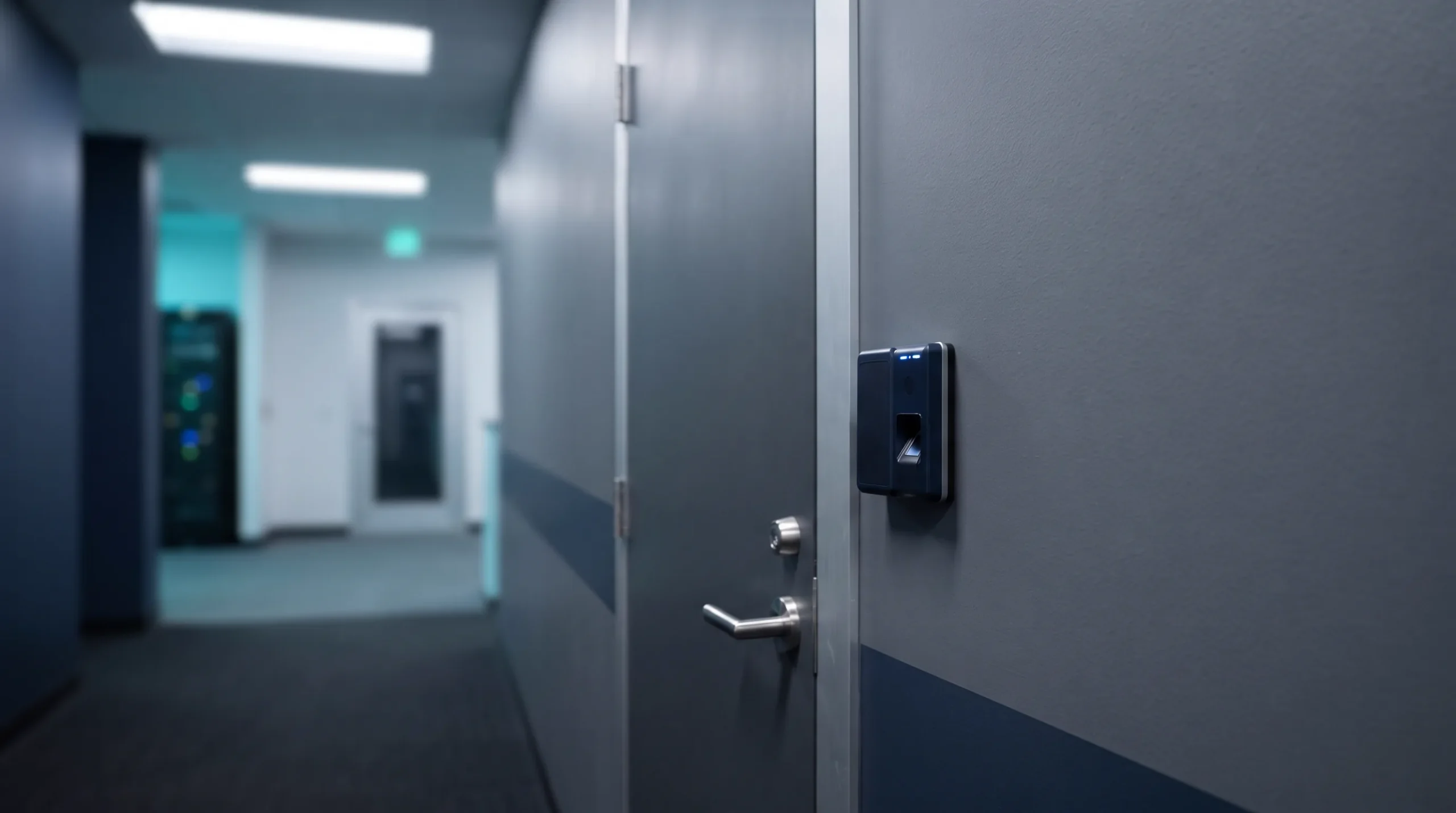
Biometric access control opens a door by matching a physical trait, usually a fingerprint or a face, against an enrolled template instead of checking a card or code. It suits a few high-value doors. In Texas it also carries legal duties around consent, storage and deletion, with penalties up to $25,000 per violation.
We install biometric access control systems for DFW businesses, and we talk about as many owners out of them as into them. A fingerprint reader on a pharmacy cage makes sense. One on the front door of a 30-person office usually doesn’t. Here’s how the technology works, where it earns its cost, and what Texas law expects before you scan anyone’s finger.
How does biometric access control work?
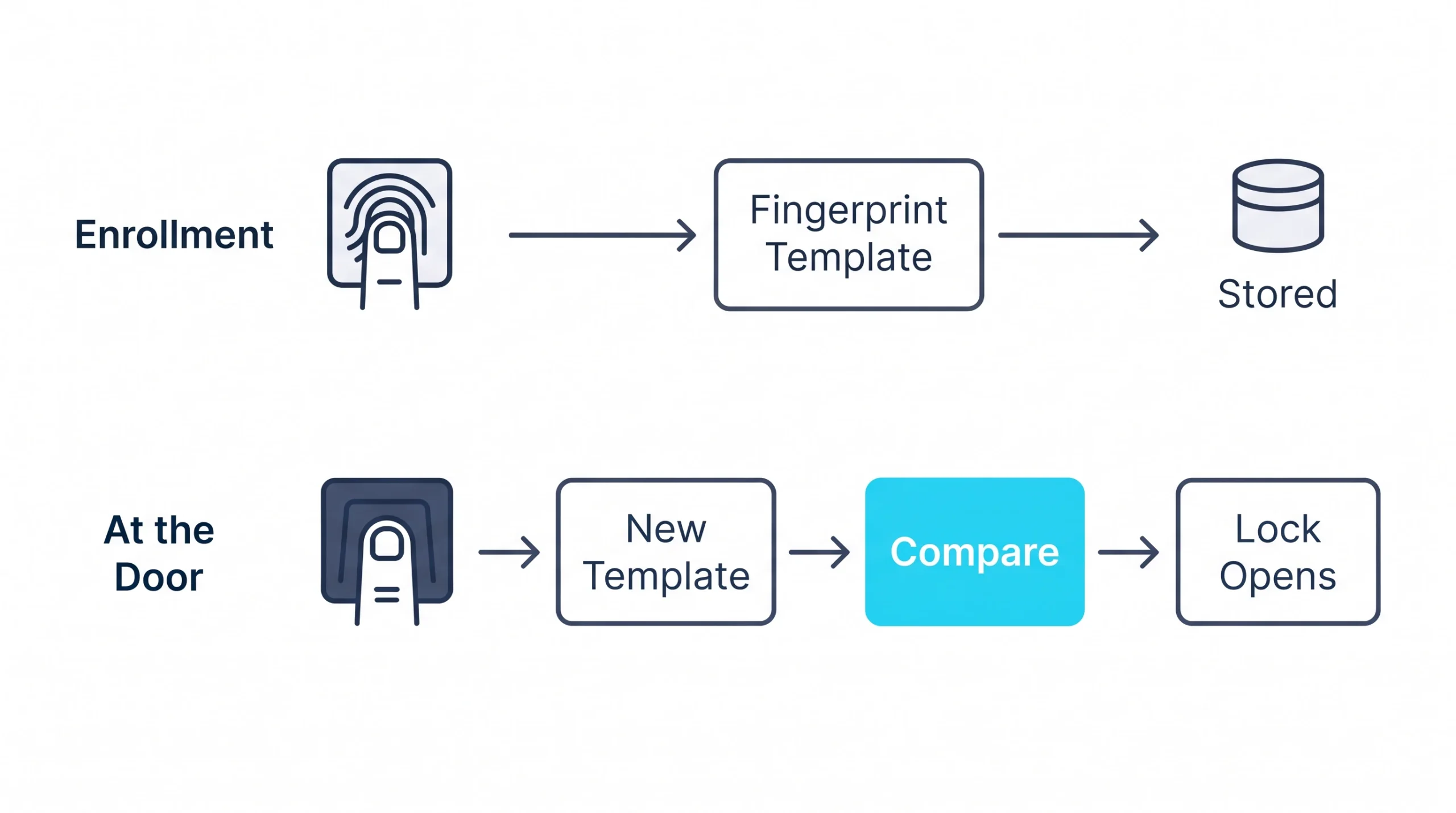
During enrollment, the reader scans a trait and converts it into a mathematical template. It doesn’t keep a photograph. At the door, a fresh scan becomes a new template and the system compares the two. A close enough match releases the lock, typically in about a second.
Two details decide how well that works in practice. The first is matching mode. In one-to-one mode you present a card and then your finger, and the system checks you against your own template. In one-to-many mode you present only the finger and the system searches everyone enrolled. One-to-one is faster and more accurate. The second is where templates live: on the reader, on a server, in the vendor’s cloud or on the employee’s own card. That choice matters for the legal section below.
Fingerprint, face, palm or iris: matching the type to the door
Two things we’ve learned on North Texas job sites that the brochures leave out. Fingerprint readers reject people who work with their hands: machinists, HVAC techs and kitchen staff show up as false rejects far more often than office workers. And a west-facing exterior reader in August sun is a bad location for any biometric. Face readers wash out and metal fingerprint sensors get too hot to touch. Put biometrics indoors or under cover.
Is biometric access control legal in Texas?
Yes, with conditions. Under Texas Business and Commerce Code §503.001, a business must inform a person before capturing a biometric identifier and get consent. It must protect the data with reasonable care, may not sell it, and must destroy it within a year after the purpose ends.
The statute defines a biometric identifier as a retina or iris scan, fingerprint, voiceprint, or record of hand or face geometry. For employers there’s a specific clock: when identifiers are collected for security purposes, the purpose is presumed to expire when the employment relationship ends. The one-year destruction deadline runs from that date.
Violations carry a civil penalty of up to $25,000 each, and the Texas Attorney General has exclusive authority to enforce the law. Employees can’t sue under it directly, but the state does use it. In July 2024 the Attorney General announced a $1.4 billion settlement with Meta over facial recognition, brought in part under this statute.
We’re installers, not attorneys, so have counsel review your consent form. What we can give you is the operational checklist we build into every biometric install:
Step 6 is the one that gets missed. A retired fingerprint reader in an e-waste bin still holds every template enrolled on it. Because we handle both the door hardware and the IT side, reader wipes go on the same decommissioning checklist as hard drives.
Where biometrics earn their cost, and where they don’t
A biometric opening typically runs $3,500–$7,000 installed in the DFW market, roughly double a standard card-reader door. That premium buys one thing a card can’t: proof that the person at the door is the person enrolled. Cards get lent. Fingers don’t.
Good fits are rooms where that proof matters: a server room, a controlled-substance cage, a cash office, a records vault. Poor fits are main entrances with visitors, sites with high staff turnover and outdoor gates.
Biometrics also don’t replace your access policy. A fingerprint is a credential, a way of proving identity. Which doors that identity opens, and when, still comes from the role-based access model behind it.
Our take: for most offices, the better route to biometric security is the one employees already carry. With mobile credentials, the phone’s own face or fingerprint check gates the door key, and the biometric never leaves the employee’s device. Your business doesn’t collect it, so there’s nothing for you to store or delete.
Here’s a case where a dedicated reader is the right call. A compounding pharmacy in McKinney with 14 employees runs its entrances on fobs. The controlled-substance room gets a card-plus-fingerprint reader in one-to-one mode. Nine staff are enrolled, each with a signed consent form on file, and templates stay on the reader instead of a cloud service. Because the same provider delivers the pharmacy’s managed IT services in McKinney, disabling a departing technician’s login and deleting the fingerprint template happen in one offboarding ticket.
If it were our building: biometrics on one or two rooms, always paired with a card, never as the only way through an exit route.
Not sure a door justifies it? Ask us which doors in your building qualify. For standard doors, our per-door cost guide covers the rest of the system.
Two misconceptions worth correcting
“It’s only a template, so privacy law doesn’t apply.” Don’t count on that. The Texas statute covers fingerprints and records of hand or face geometry without carving out templates. Treat the template as the regulated data.
“Biometrics can’t be fooled.” Cheap readers can be, with a lifted print or a photo. Commercial-grade readers add liveness detection that checks for a real finger or a three-dimensional face. Ask for it by name, and ask the installer to demonstrate it.